In May, an 11% sequential drop in integrated-circuit revenue took a third off Photronics in a single session and produced a securities class action. On Wednesday morning the same line came back positive — and the stock did what you would expect.
Photronics is not a household name, but almost every chip in the device you are reading this on passed through something the company made. It manufactures photomasks: the quartz-and-chrome master templates that lithography machines use to project circuit patterns onto silicon wafers. It is a small, unglamorous, high-margin corner of the semiconductor supply chain, and it is unusually sensitive to one thing — whether customers are actually releasing new chip designs into production. Before the bell on Wednesday, August 26, $PLAB reported fiscal third-quarter results showing that they are, and the stock jumped roughly 17% in pre-market trading. The company’s release went out over GlobeNewswire and was carried in full here; StockTitan and StockAnalysis carried the reaction, and TradingView published the consensus estimates going in.
What makes the quarter worth a closer look is not the size of the beat but which line delivered it — and what happened the last time that line went the other way.
Company snapshot
- Company: Photronics, Inc. · Ticker: PLAB (NASDAQ)
- Sector: Technology · Semiconductor equipment & materials · Photomasks
- Headquarters: Brookfield, Connecticut · Founded 1969 in Danbury, Connecticut as Photronic Labs, Inc.; public on NASDAQ since 1987
- CEO: George Macricostas, chairman and chief executive since May 2025 · President & CFO: Eric Rivera
- Segments: Integrated Circuit (IC) photomasks and Flat Panel Display (FPD) photomasks
- Manufacturing footprint: Brookfield CT, Allen TX and Boise ID in the U.S.; Taiwan, South Korea, China and Singapore in Asia; Dresden, Manchester and Neuchâtel in Europe
- Joint ventures: PDMC in Taiwan (formed 2014) and a China venture (formed 2018), both with Dai Nippon Printing; Photronics holds 50.01%
- Dividend: None — Photronics does not pay one
- Employees: ~1,908 · Approx. market cap: ~$1.73B · Prior close: $29.32 (Aug 25, 2026)
Company facts verified against the company’s published corporate timeline, its investor-relations disclosures, and the Q3 fiscal 2026 earnings release. Price, share-count and market-cap figures sourced below.
What actually happened
Photronics reported results for its fiscal third quarter, the period ended August 2, 2026, before the market opened on Wednesday. Revenue was $216.0 million, up 2.7% from a year earlier and up 2.9% sequentially. Analysts had modeled roughly $208.8 million, so the top line cleared by about $7 million.
Earnings cleared by more. Non-GAAP net income attributable to Photronics shareholders was $29.4 million, or $0.50 per diluted share, against a consensus estimate of $0.40 — a 25% beat on the bottom line. On a GAAP basis the company earned $28.9 million, or $0.49 per diluted share, up from $22.9 million and $0.39 in the year-ago quarter. Gross margin came in at 33.2% and operating margin at 21.1%, both healthy for a business of this size.
The segment detail is where the story lives. IC photomask revenue was $154.7 million, up 5% year over year and up 5% sequentially, while FPD revenue was $61.4 million, down 2% on both measures. Within the IC business, high-end work — the advanced-node masks that carry the best pricing — reached a record 44% of segment revenue. Management attributed the improvement to a recovery of semiconductor design releases that had been temporarily delayed out of the prior quarter, alongside high customer fab utilization pushing migration to more advanced nodes. For fiscal Q4, ending October 31, the company guided revenue of $207 million to $227 million, operating margin of 19% to 24%, and non-GAAP diluted EPS of $0.40 to $0.56.
The numbers that moved it
| Metric | Q3 FY2026 result | Street / prior year |
|---|---|---|
| Revenue | $216.0M (+2.7% YoY, +2.9% q/q) | ~$208.8M est. — beat |
| Non-GAAP diluted EPS | $0.50 | $0.40 est.; $0.51 prior year |
| GAAP diluted EPS | $0.49 | $0.39 prior year (+26%) |
| IC photomask revenue | $154.7M (+5% YoY, +5% q/q) | −11% q/q in fiscal Q2 |
| FPD photomask revenue | $61.4M (−2% YoY, −2% q/q) | — |
| High-end share of IC revenue | 44% (company record) | — |
| Gross margin | 33.2% | — |
| Operating margin | 21.1% | 19–24% guided for Q4 |
| Operating cash flow / capex | $76.3M / $37.0M | — |
| Q4 FY26 non-GAAP EPS guide | $0.40 – $0.56 | midpoint $0.48 vs $0.50 just delivered |
Sources: Photronics Q3 fiscal 2026 earnings release (GlobeNewswire), StockTitan, StockAnalysis, TradingView consensus data. Non-GAAP figures as reported by the company.
Note the last row. The Q4 guide brackets the quarter just delivered rather than stepping over it: the $0.48 midpoint sits two cents below the $0.50 Photronics just earned, and the $207 million bottom of the revenue range is below the $216.0 million it just booked. This was a beat on the quarter, not a raise on the year. That distinction matters when you are deciding what a 17% gap up is actually paying for.
Six months of tape
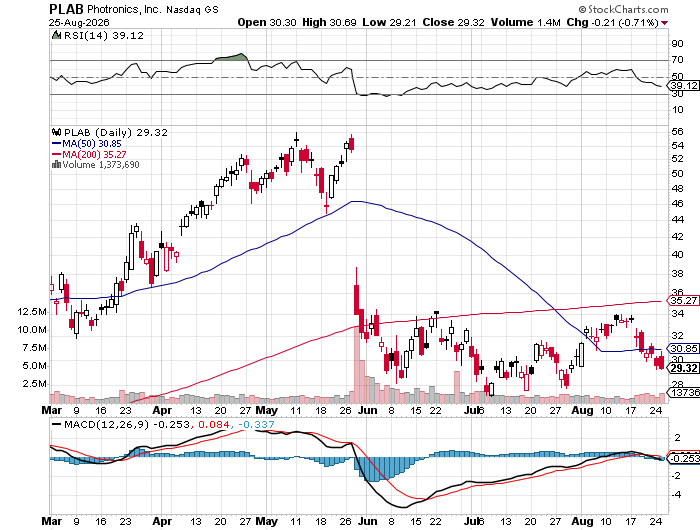
The chart explains the violence of the reaction better than any earnings line does. On May 27, 2026, Photronics closed at $53.51. On May 28 — after reporting fiscal Q2 revenue of roughly $209.9 million, essentially flat year over year and short of estimates, along with that 11% sequential decline in IC revenue and an acknowledgment that the expected post-Lunar-New-Year recovery had not materialized because customers pushed out product launches — it closed at $34.02. A 36% decline in one session, against a 52-week range of $20.05 to $56.00.
So Wednesday’s move is not a fresh breakout. It is a stock that lost more than a third of its value on one data point getting some of it back when that data point reversed. At a pre-market price near $34, PLAB is roughly back to where it closed on the day of the crash — and still well below where it traded the day before.
Inside the business: who actually owns the profits
Photronics runs a merchant photomask business: it makes masks for other companies rather than for its own chips, selling to foundries, integrated device manufacturers and panel makers. Every time one of them moves a design into production, or shrinks it to a more advanced node, it needs a new mask set. That is why design-release activity, not end-device demand, is the variable that swings this P&L.
The IC segment is the larger and higher-quality half of the business — about 72% of revenue this quarter — and within it, the high-end category is what investors watch. Advanced-node masks are harder to make, priced accordingly, and the record 44% mix is the single most bullish disclosure in the release. The FPD segment, which serves display makers, is the slower half; it shrank 2% and has been the weaker line for some time.
There is a structural wrinkle that a headline EPS number hides. A significant portion of Photronics’ Asian manufacturing sits inside joint ventures with Dai Nippon Printing — PDMC in Taiwan, formed in 2014, and a China venture formed in 2018 — in which Photronics holds 50.01% and DNP holds the rest. Photronics consolidates those ventures, so their full revenue appears on the top line, but roughly half of their economics belongs to DNP. The cash disclosure makes this concrete: of the $672.8 million in cash, equivalents and short-term investments the company reported, $503.5 million sits at those 50.01%-owned joint ventures. That is a real balance sheet, but it is not all a Brookfield, Connecticut balance sheet. The consolidated position is nonetheless conservative — total debt is under $4 million, and enterprise value is roughly $1.1 billion against a $1.73 billion market cap.
Competitively, Photronics is one of a small handful of merchant mask makers, alongside Dai Nippon Printing, Hoya, Toppan’s photomask business and Taiwan Mask Corporation — and it also competes against the captive mask shops large chipmakers run in-house, which is a permanent ceiling on the addressable market.
Why the market bought it
Three things stacked up. First, the beat was on quality rather than accounting: $7 million of revenue upside converted into a ten-cent EPS beat, which is operating leverage, not a tax rate. Second, the line that recovered is the exact line whose deterioration caused the May collapse, so the print reads as evidence that the Q2 shortfall was timing rather than demand. Third, the stock went in cheap on trailing numbers — around 11 times earnings and 1.4 times book — with sentiment already washed out, which is the setup in which a modest beat produces an outsized move.
The bear case and what to watch
Start with the litigation, because it is the most concrete risk on the page. A securities class action is pending against Photronics on behalf of purchasers between December 10, 2025 and May 27, 2026, alleging that the company overstated the strength and sustainability of customer demand and created an impression of reliable visibility into future revenue that the May results contradicted. The lead-plaintiff deadline is September 4, 2026. These are allegations, not findings, and Photronics has not been adjudicated liable of anything — but the case is live, it is being actively publicized by plaintiffs’ firms, and defending it costs money and management attention.
The second concern is that one good quarter does not establish a trend, and the company’s own guidance declines to claim one. Revenue grew 2.7% year over year. Non-GAAP EPS of $0.50 is actually a penny below the $0.51 earned in the year-ago quarter. Q4 guidance brackets rather than exceeds the result. This is a business stabilizing after a scare, not one inflecting into growth.
Beyond that: the FPD segment keeps shrinking and is roughly 28% of revenue; customer concentration is real, since a single large foundry or IDM delaying a product ramp is precisely what produced the May quarter; capital intensity does not go away, with $37.0 million of capex against $76.3 million of operating cash flow this quarter; and a manufacturing base weighted toward Taiwan, China and South Korea sits inside the most contested supply chain in the world.
What to watch is specific. First, whether IC revenue posts a second consecutive sequential increase in fiscal Q4 — one quarter is a rebound, two is a recovery. Second, whether the high-end mix holds above 40% or gives back the record. Third, where actual Q4 results land within that wide $0.40 to $0.56 range, because the width of the band is itself a statement about visibility. Fourth, developments in the class action after the September 4 lead-plaintiff deadline. And fifth, whether the gap holds: a 17% pre-market move on an earnings print is exactly the kind of gain that can be sold into once regular-session liquidity arrives.
The bottom line
Photronics did the one thing it needed to do: the metric that broke the stock in May — sequential IC photomask revenue — came back positive, and the high-end mix hit a company record. That is a genuinely good quarter, and the reaction is rational.
It is also a narrow one. Revenue growth is low single digits, non-GAAP EPS is flat against last year, guidance implies no acceleration, the display business is still contracting, a securities class action is pending, and a meaningful share of the consolidated cash and earnings belongs to a joint-venture partner. An undemanding valuation and a nearly debt-free balance sheet give the bull case a floor. But this is a cyclical supplier in a cycle that has not clearly turned, and Wednesday’s move restores a fraction of what one bad quarter took away rather than opening a new chapter. The recovery is real; whether it is durable is a question fiscal Q4 will answer, not this one.
Get the next Top Stock Pick in your inbox — free.
Recent Top Stock Picks
- Dick’s Bought Foot Locker to Buy Growth. This Quarter It Bought a Loss Instead.
- NAPCO’s Record Quarter Sent It Up 21% – But Check Which Nine Cents Did the Work
- Moderna Just Cleared the Bar That No mRNA Cancer Therapy Ever Had
- VWAV Stock: VisionWave Rips 45% on Volume Into Aug 20 Earnings — The Defense-AI Micro-Cap Traders Are Watching
This report is for information purposes only, and is neither a solicitation or recommendation to buy nor an offer to sell securities. TopStockPicks.co is not a registered investment advisor and is not a broker-dealer. TopStockPicks.co has NOT BEEN COMPENSATED for coverage of PLAB. TopStockPicks.co and its affiliates or officers may buy and sell shares of PLAB in the open market at any time without notice. TopStockPicks.co does not set price targets on securities. Always do your own due diligence and consult your financial advisor. Never invest into a stock discussed by TopStockPicks.co unless you can afford to lose your entire investment.