A record fourth quarter, a 53% jump in net income and a dividend increase sent $NSSC up more than 20% before the bell — but roughly nine cents of the fifty-cent quarter came from a refund, not from the business.
Small-cap industrials do not usually gap 20% on an earnings print. NAPCO Security Technologies carries a market value around $1.36 billion, the kind of company that moves a few percent on results and goes back to being ignored. So when $NSSC traded near $46 in the pre-market on August 24 — up roughly 21% from Friday’s $38.09 close — the size of the reaction said the market had been braced for something duller. The company’s own numbers are worth reading straight from the source: the full fiscal Q4 and full-year release went out on PR Newswire before the open, and StockTitan and Investing.com both carried the print and the market reaction.
This profile walks through what NAPCO actually reported, the recurring-revenue engine that has quietly re-rated this company over the last several years, the one-time item flattering the headline, and the specific reasons to be careful at $46 rather than $38.
Company snapshot
- Company: NAPCO Security Technologies, Inc. · Ticker: NSSC (NASDAQ)
- Sector: Industrials · Electronic security, fire alarm and life-safety equipment
- Headquarters: Amityville, New York · Founded more than 55 years ago by Richard Soloway
- CEO & President: Kevin Buchel (effective July 8, 2026)
- Executive Chairman: Richard Soloway, founder, who also remains Chairman of the Board
- Brands: NAPCO Security Systems · Alarm Lock · Continental Access · Marks USA · Napco Access
- Approx. market cap: ~$1.36B · Shares outstanding: ~35.7M · 52-week range: $30.03–$48.12
Snapshot figures are drawn from the company’s own release and website and from market data providers; the quarterly results are sourced in the table below.
What actually happened
NAPCO reported results for its fiscal fourth quarter and full year 2026 — the quarter ended June 30, 2026 — before the market opened on Monday, August 24. It cleared the bar on both lines that matter.
Quarterly net sales rose 10.0% to a record $55.8 million, from $50.7 million a year earlier. Analysts had been looking for roughly $53 million. Net income climbed 52.7% to $17.8 million from $11.6 million, and diluted earnings per share came in at $0.50 against $0.33 a year ago — comfortably ahead of a consensus sitting near $0.39 to $0.40. The board then raised the quarterly dividend by 13.3% to $0.17 per share, payable October 2, 2026.
That combination — a revenue record, a better-than-50% earnings jump, and a dividend increase in the same release — is what produced the gap. A beat alone rarely moves a stock this much. A beat that management pairs with a capital-return increase reads as confidence, because a dividend raise is harder to walk back than a forecast.
The numbers that moved it
| Metric | Q4 FY2026 | Q4 FY2025 / Street |
|---|---|---|
| Net sales | $55.8M (record) | $50.7M (+10.0%) |
| Equipment revenue | $30.5M | $28.3M |
| Recurring service revenue | $25.3M | $22.4M (+12.9%) |
| Gross profit | $34.2M | $26.8M |
| Gross margin | 61.3% | 52.8% |
| Net income | $17.8M | $11.6M (+52.7%) |
| Diluted EPS | $0.50 | $0.33 (~$0.39–$0.40 est.) |
| Quarterly dividend | $0.17 | raised 13.3% |
| Stock reaction | ~$38.09 → ~$46.19 | +21% pre-market |
Sources: NAPCO Security Technologies fiscal Q4 and full-year 2026 results release (PR Newswire, August 24, 2026); StockTitan; Investing.com; stockanalysis.com. Pre-market price as of 7:50 AM ET.
For the full year, net sales rose 11.4% to a record $202.3 million and recurring service revenue reached $97.5 million, up 13.0%. The balance sheet finished the year with $126.9 million in cash and cash equivalents plus $10.6 million in marketable securities, against no meaningful debt burden disclosed in the release — a genuinely conservative position for a company of this size.
Six months of tape
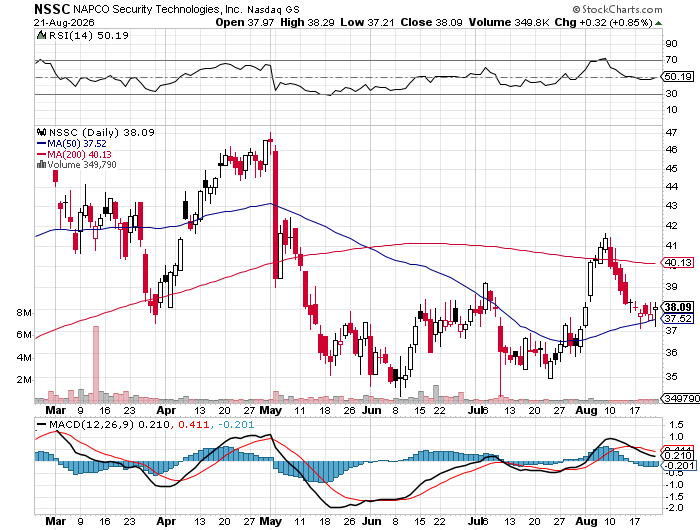
The chart supplies context the one-day pop hides. NSSC has spent the year working back from the low $30s, and a print near $46 puts it within a couple of dollars of its 52-week high of $48.12. This is not a stock breaking out of a long base into clear air — it is a stock gapping into the top of its own established range. That distinction matters for anyone deciding whether to chase.
Inside the business: the razor and the blade
NAPCO manufactures electronic security equipment and, increasingly, sells the service that keeps it connected. Understanding the split between those two revenue lines is the whole investment case.
The equipment side is the traditional business: intrusion alarm systems sold under the Gemini line, commercial fire alarm systems including the Firewolf and FireLink families, access control through Continental Access and the newer Napco Access and MVP cloud platforms, and physical locking hardware through Alarm Lock and Marks USA. The company also markets a connected-home product, Prima, and has built a distinct franchise in school safety solutions — a segment with an unfortunate but durable demand driver.
The recurring side is where the re-rating came from. NAPCO’s StarLink universal wireless communicators connect intrusion and fire alarm panels to central monitoring stations over cellular networks. Once a StarLink radio is installed in a building, it generates a monthly service fee for as long as it stays there — and alarm panels are not devices anyone rips out casually. That is a classic razor-and-blade model: sell the hardware once, collect the subscription indefinitely.
The economics show up in the margin line. Recurring service revenue reached $25.3 million in the quarter, up 12.9%, and $97.5 million for the full year, up 13.0%. Management pointed to a prospective annual run rate of approximately $103 million based on July 2026 recurring revenues. For a company that did $202.3 million in total sales, roughly half the business is now subscription revenue that arrives whether or not a distributor places an order that month. Service revenue carries structurally higher margins than hardware, so as the mix shifts, the blended gross margin rises almost mechanically.
This is also the first full set of results reported under new leadership. Kevin Buchel became CEO and President on July 8, 2026, after more than 25 years at the company and roughly two years as President and Chief Operating Officer. Founder Richard Soloway, who built the business over more than five decades, moved to Founder and Executive Chairman while remaining Chairman of the Board. Succession at a founder-led company is a real risk event; this one was handled as an internal promotion of a long-tenured operator rather than an outside hire, which is the lower-variance version.
Why the market rewarded it
Three things stacked up. First, the beat was on both lines — revenue and earnings — so there was no “beat on cost control, missed on demand” asterisk to argue about. Second, the recurring-revenue line kept compounding at a low-teens rate, which is the number that justifies NAPCO trading at a software-adjacent multiple rather than a hardware multiple. Third, the dividend increase landed in the same release, and a 13.3% raise from a brand-new chief executive is a deliberate signal about the durability of the cash flows underneath.
There is a positioning element too. NSSC came into the print having spent much of the year below its highs, with a consensus that was, by the standards of this company, cautious. When expectations are set near $0.39 and the company delivers $0.50, the gap is arithmetic as much as it is enthusiasm.
The case for caution
Here is the fine print, and it is material. Approximately $0.09 of that $0.50 in quarterly earnings per share came from net tariff refunds — a one-time item, not operating performance. Back it out and the quarter is closer to $0.41, which is a beat, but a far more ordinary one.
The same item does even more work on the margin line. Gross margin expanded from 52.8% to 61.3%, an eye-catching 850 basis points. Roughly 600 of those basis points came from the tariff refunds. The underlying, repeatable gross margin is therefore somewhere in the mid-50s — still an improvement year over year, driven by the recurring-revenue mix shift, but nothing like the headline. Anyone modelling 61% margins forward is modelling a refund that does not repeat.
The full-year picture is more sobering than the quarter. Diluted EPS for fiscal 2026 was $1.20, up just 0.8% from the prior year. The reason is a $16 million litigation settlement charge taken in the third quarter of fiscal 2026, which cost roughly $0.40 per share for the year. Revenue grew 11.4%; earnings essentially did not grow at all. A single quarter’s record does not undo that.
Two more watch-items. NAPCO issued no formal forward guidance in this release — only commentary on momentum and that RSR run-rate figure. Investors buying the gap are extrapolating without a company forecast to anchor to. And NSSC is a relatively thinly traded stock, averaging roughly 350,000 to 370,000 shares a day over the past three months. Thin average volume is what allows a 21% gap in the first place, and it cuts in both directions: the same illiquidity that produces a violent move up produces one down when a quarter disappoints.
What to watch next
The immediate tell is whether NSSC holds the gap once regular trading begins. Pre-market moves are made on light volume and routinely give back ground when the full market arrives, so the close matters far more than the 7:50 AM quote. Beyond the tape, the number that actually determines this company’s multiple is recurring service revenue: whether it keeps compounding in the low teens and whether that ~$103 million run rate is met or beaten. The second is clean gross margin — specifically what it prints in the first quarter of fiscal 2027 without a tariff refund in it. That figure will settle the argument about whether the mix shift is genuinely lifting profitability or whether this quarter was mostly a customs windfall.
The bottom line
NAPCO delivered a genuine record: net sales of $55.8 million, recurring revenue compounding at nearly 13%, net income up 53%, and a dividend raise from a new chief executive in his first reported quarter. The subscription engine underneath is real, durable, and the honest reason this company has re-rated over the past several years. But the headline was flattered — about nine cents of earnings and roughly two-thirds of the margin expansion came from a one-time tariff refund, and the full year grew earnings by less than a percent after a $16 million litigation settlement. The business is better than the full-year number and not as good as the quarter. At $38 the market was underwriting the first of those; near $46, close to the 52-week high and with no company guidance to lean on, it is underwriting the second.
Get the next Top Stock Pick in your inbox — free.
Recent Top Stock Picks
- Moderna Just Cleared the Bar That No mRNA Cancer Therapy Ever Had
- VWAV Stock: VisionWave Rips 45% on Volume Into Aug 20 Earnings — The Defense-AI Micro-Cap Traders Are Watching
- JFB Stock: Inside the XTEND AI-Robotics Merger Turning a Construction Ticker Into an Autonomous-Defense Play
- HeartFlow Raised Guidance for the Second Straight Quarter — and $HTFL Gapped 25% Before the Bell
This report is for information purposes only, and is neither a solicitation or recommendation to buy nor an offer to sell securities. TopStockPicks.co is not a registered investment advisor and is not a broker-dealer. TopStockPicks.co has NOT BEEN COMPENSATED for coverage of NSSC. TopStockPicks.co and its affiliates or officers may buy and sell shares of NSSC in the open market at any time without notice. TopStockPicks.co does not set price targets on securities. Always do your own due diligence and consult your financial advisor. Never invest into a stock discussed by TopStockPicks.co unless you can afford to lose your entire investment.