A personalized cancer vaccine built from a patient’s own tumor beat Keytruda alone in a late-stage melanoma trial — the first time any mRNA cancer therapy has won a Phase 3. $MRNA repriced violently before the bell.
For years the bear case on Moderna wrote itself: a company that got extraordinarily lucky once, built a large market value on a pandemic that ended, and has been shrinking back toward its research-lab origins ever since. Second-quarter 2026 revenue was $145 million. Not billion — million. That is what a collapsed COVID franchise looks like on an income statement.
Then, before the open on August 19, 2026, Moderna and Merck announced that their personalized cancer vaccine had met its goals in a Phase 3 trial, and the stock stopped trading like a post-pandemic runoff story. The result was covered by CNBC, Bloomberg, Fierce Biotech and Investing.com, and the joint press release is available in full.
This profile walks through what the trial showed, what it did not show, why the readout matters far beyond melanoma, what the rest of Moderna’s business looks like underneath the headline, and the reasons to stay careful after a move this size.
Company snapshot
- Company: Moderna, Inc. · Ticker: MRNA (NASDAQ)
- Sector: Healthcare · Biotechnology, mRNA vaccines and therapeutics
- Headquarters: Cambridge, Massachusetts · Founded 2010
- CEO: Stéphane Bancel, chief executive since October 2011
- Marketed products: Spikevax and mNEXSPIKE (COVID-19) · mRESVIA (RSV) · mCOMBRIAX (combination) · mFLUSIVA (influenza)
- Approx. market cap: ~$25.1B · Prior close: $64.46 (Aug 18, 2026)
- 3-month average volume: ~4.3 million shares
Snapshot figures are company facts verified against Moderna’s corporate disclosures and market data; the trial results and financials are sourced below.
What actually happened
Merck and Moderna reported positive topline results from INTerpath-001, a Phase 3 trial of intismeran autogene — previously mRNA-4157 or V940 — given with Merck’s immunotherapy Keytruda.
The trial enrolled 1,137 patients whose cutaneous melanoma had been completely removed by surgery, spanning stages IIB through IV, randomized 2:1 to intismeran autogene plus Keytruda or Keytruda alone for roughly one year. This is the adjuvant setting: the visible tumor is already gone, and the point of treatment is to stop the cancer from coming back.
The combination met its primary endpoint of recurrence-free survival, meaning patients who got the vaccine went longer without their melanoma returning than patients who got Keytruda by itself. It also met a key secondary endpoint of distant metastasis-free survival — the cancer was less likely to spread to distant organs, which is the event that turns a survivable melanoma into a lethal one. Both improvements were described as statistically significant and clinically meaningful. The companies reported no new safety signals, with side effects consistent with earlier studies of the combination.

The numbers that moved it
| Item | Detail | Note |
|---|---|---|
| Trial | INTerpath-001, Phase 3 | Adjuvant melanoma |
| Patients enrolled | 1,137 | Randomized 2:1 |
| Population | Resected stage IIB–IV cutaneous melanoma | No prior systemic therapy |
| Primary endpoint | Recurrence-free survival | Met — statistically significant |
| Key secondary | Distant metastasis-free survival | Met |
| Overall survival | Not reported | Trial continues to assess |
| Safety | No new safety signals | Consistent with prior studies |
| Prior close | $64.46 | Aug 18, 2026 |
Sources: Merck/Moderna joint press release, CNBC, Bloomberg, Fierce Biotech, Investing.com, stockanalysis.com. Topline results only; detailed data not yet released.
One number is conspicuously absent, and its absence is the most important thing about this announcement: the companies did not release the magnitude of the benefit. No hazard ratio, no median recurrence-free survival, no curves. “Statistically significant” means the effect is unlikely to be chance. It does not tell you whether the effect is large enough to change practice or justify manufacturing a bespoke therapy for every patient. That data comes at a future medical meeting.
The pre-market reaction was correspondingly chaotic. Feeds showed dramatically different numbers depending on the minute they were sampled — early reports described a gain of more than 10%, later reads roughly 50%, then 61%, while stockanalysis.com quoted $129.00 against the $64.46 prior close. A spread that wide is itself information: price discovery was still happening in real time on thin liquidity, which is why no single percentage should be treated as the move.
Six months of tape
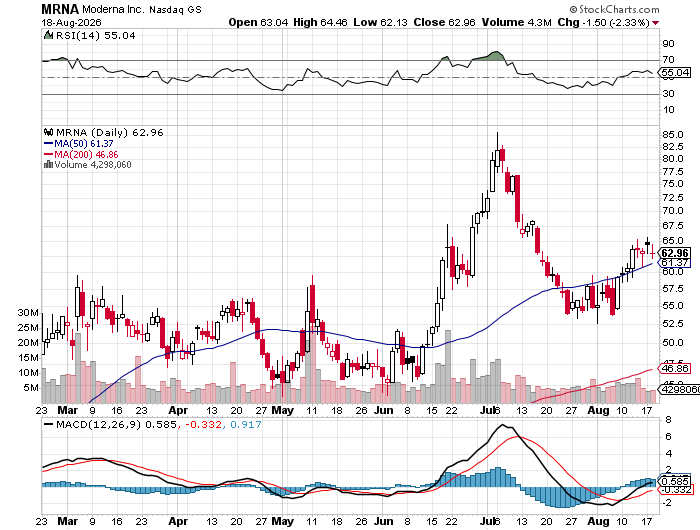
Context matters here. Moderna did not gap higher from a position of strength — it gapped from a base that reflected years of investor disillusionment. The stock spent mid-2026 in the low-to-mid $60s, valuing the company near $25 billion against $6.9 billion of cash and investments at June 30, 2026. Strip out the cash and the market was assigning strikingly little to the entire mRNA platform. That is what makes a repricing of this magnitude arithmetically possible: expectations were on the floor.
Why this readout matters more than melanoma
If this were only a new option for melanoma patients, the reaction would have been far smaller. Melanoma is serious — the American Cancer Society estimates roughly 112,000 new invasive cases and 8,510 deaths in the United States in 2026 — but on its own it is not a $25 billion market.
The reason the market repriced so violently is that this is the first positive Phase 3 result for an individualized neoantigen therapy, and the first for any mRNA-based cancer therapy. That is a platform validation, not a product approval.
The concept is genuinely different from a conventional drug. A patient’s tumor is sequenced, the mutations unique to it are identified, and a custom mRNA therapy is manufactured to train that individual’s immune system to recognize them. Every dose is made for one person. For a decade this was a compelling hypothesis with no Phase 3 evidence behind it. As of this morning it has some.
The read-through runs two ways. Within the partnership, intismeran autogene is already in pivotal Phase 3 testing in adjuvant and earlier-stage non-small cell lung cancer, a far larger indication than melanoma; a mechanism that works in one adjuvant setting is more likely — not certain — to work in another. More broadly, Moderna’s whole argument has been that mRNA is a platform, not a product. Oncology was the most valuable and least proven branch of that argument.
Inside the rest of the business
Underneath the headline, Moderna is in the middle of a difficult transition, and this profile would be dishonest without saying so plainly.
The respiratory franchise is the commercial base: Spikevax and mNEXSPIKE for COVID-19, mRESVIA for RSV, and the combination vaccine mCOMBRIAX. Second-quarter progress included a COVID vaccine collaboration in Brazil and an EU joint procurement contract for up to 24 million mRESVIA doses. A real business — but seasonal, heavily Q4-weighted, and a fraction of its pandemic-era scale.
Influenza is the newest addition, and a genuine milestone. On August 5, 2026, the FDA approved mFLUSIVA (mRNA-1010) for adults 50 and older — the first mRNA influenza vaccine ever approved. The approval is age-stratified: full approval for ages 50 to 64 based on the Phase 3 FLUENT trial of 40,805 participants, and accelerated approval for those 65 and older based on an immunogenicity trial of 2,992, contingent on a confirmatory post-marketing study. Relative vaccine efficacy against standard-dose flu vaccine was 26.6%.
The financials are the sober part. Second-quarter 2026 revenue was $145 million against $142 million a year earlier. Cash, cash equivalents and investments stood at $6.9 billion at June 30, 2026 — before a $950 million litigation payment in July. Moderna guides to year-end 2026 cash and investments of $4.7 to $5.2 billion while targeting up to 10% revenue growth. A company drawing down that much cash in a year is on a clock, however good the science is.
And not everything works. The norovirus candidate mRNA-1403 failed to meet the statistical criteria for early success at an interim Phase 3 analysis. That is the honest counterweight to today’s news: the platform produces failures as well as firsts.
The case for caution
This is where anyone tempted to chase the gap needs to slow down.
Topline is not data. No effect size has been disclosed. A result can be statistically significant and commercially underwhelming at the same time, and until the curves are presented, nobody outside the companies knows which this is.
Overall survival has not been reported. The trial continues in order to assess it. Delaying recurrence is valuable, but the question regulators, payers and physicians ultimately care about is whether patients live longer — and that answer does not exist yet.
There is no filing date. The companies said they plan to present the data at an upcoming medical meeting and to engage regulators about submissions — meaningfully vaguer than a submission timeline. Engagement is not filing, and filing is not approval.
Manufacturing is the unsolved commercial problem. Producing an individualized therapy per patient — sequencing a tumor, designing a construct, manufacturing and shipping it inside a clinically useful window — is slow and expensive. Doing it for a trial is hard; doing it for a global launch is a different discipline, and the economics remain unproven.
Moderna does not own this alone. Keytruda is Merck’s — $31.7 billion in 2025 sales, up 7%, with Merck pointing to peak sales near $35 billion by 2028 before exclusivity ends. The therapy is a combination and the economics are shared. Merck stock moved a fraction of what Moderna’s did, which tells you how the market apportioned the news.
Finally, the move itself is a risk. A stock that reprices this far in one pre-market session on a topline press release has priced in a great deal of good news before the details exist. Pre-market moves can and do reverse at the open, and gaps this size frequently see violent two-way trading afterward.
The bottom line
Something genuinely important happened in oncology this morning. The first Phase 3 win for an mRNA cancer therapy is a real scientific milestone, it validates a platform the market had written down toward its cash value, and it strengthens a program already running in a much larger lung cancer indication.
It is also a press release with no effect size, no survival data, no filing date and an unsolved manufacturing problem — attached to a company that booked $145 million of revenue last quarter and is spending down its cash. Both things are true at once. The science got much better today; the valuation got much more demanding today. Those are not the same event, and the gap between them is where the risk lives.
What to watch next
- The medical meeting presentation — the hazard ratios and survival curves that decide whether today was justified.
- Overall survival as the trial continues to mature.
- A concrete regulatory filing timeline from either company.
- The NSCLC program, where the addressable population is far larger than melanoma.
- Cash burn against the guided $4.7–$5.2 billion year-end 2026 range.
- Where the stock settles after the open, rather than where it was indicated pre-market.
Get the next Top Stock Pick in your inbox — free.
Recent Top Stock Picks
- VWAV Stock: VisionWave Rips 45% on Volume Into Aug 20 Earnings — The Defense-AI Micro-Cap Traders Are Watching
- JFB Stock: Inside the XTEND AI-Robotics Merger Turning a Construction Ticker Into an Autonomous-Defense Play
- HeartFlow Raised Guidance for the Second Straight Quarter — and $HTFL Gapped 25% Before the Bell
- Thoma Bravo Is Taking Accelerant Private for $20.25 a Share — Still Below Its Own IPO Price
This article is for informational and educational purposes only and does not constitute financial, investment, tax, or legal advice, nor a recommendation to buy or sell any security. Top Stock Picks is not a registered investment adviser or broker-dealer. Any mention of MRNA or any other security is not a solicitation. Investing in equities involves substantial risk, including the possible loss of principal; small-cap, biotechnology and clinical-stage companies can be especially volatile, and clinical trial results, regulatory decisions and pre-market price indications are subject to change. Pre-market price movements frequently reverse once regular trading begins. Past performance is not indicative of future results. All figures cited were obtained from publicly available sources believed to be reliable as of the publication date and may become outdated or inaccurate without notice; topline clinical trial results are preliminary and full data had not been released at the time of writing. Readers should conduct their own due diligence and consult a qualified financial adviser before making any investment decision. Top Stock Picks received no compensation of any kind in connection with this article and holds no position in MRNA.