The DICK’S business is comping nearly 5% and taking share. The Foot Locker business it bought last September is now guided to lose money for the year — and on Tuesday morning the market decided which of those two facts mattered more.
There is a particular kind of earnings report that does more damage than a simple miss, and DICK’S Sporting Goods delivered one before the bell on August 25. The headline looked almost triumphant: consolidated net sales of $5.59 billion, up 53.2% from a year ago. But acquired revenue is not the same thing as growth, and underneath that number the company missed on both lines, cut its full-year profit outlook by roughly a quarter of a billion dollars at the midpoint, and told investors that the $2.4 billion sneaker chain it bought eleven months ago will operate at a loss in 2026. $DKS fell double digits in pre-market trading to a fresh 52-week low. The company’s own release is on PR Newswire, and CNBC and StockAnalysis covered the reaction.
This profile walks through what DICK’S reported, why a retailer can grow sales 53% and still lose a sixth of its value in a morning, and what has to happen for the Foot Locker bet to stop being a drag.
Company snapshot
- Company: DICK’S Sporting Goods, Inc. · Ticker: DKS (NYSE)
- Sector: Consumer Discretionary · Specialty sporting goods and athletic retail
- Headquarters: Coraopolis, Pennsylvania · Founded 1948 in Binghamton, New York
- CEO: Lauren R. Hobart (president & chief executive since February 2021) · Executive Chairman: Edward W. Stack
- DICK’S banners: DICK’S Sporting Goods · House of Sport · Field House · Golf Galaxy · Public Lands · Going Going Gone!
- Foot Locker banners: Foot Locker · Kids Foot Locker · Champs Sports · WSS · atmos
- Store base: 3,104 stores as of August 1, 2026, across roughly 20 countries
- Dividend: $1.25 per share quarterly ($5.00 annualized), a yield near 2.8% at the pre-market price
- Approx. market cap: ~$16B · Prior close: $179.33 (Aug 24, 2026)
Company facts verified against the fiscal 2026 Form 10-K, the Q2 earnings release, and the company’s completion announcement for the Foot Locker acquisition. Price and market-cap figures sourced below.
What actually happened
DICK’S reported results for the thirteen weeks ended August 1, 2026 before the market opened on Tuesday. Consolidated net sales were $5.587 billion. That is a 53.2% increase over the prior year, and essentially all of it is arithmetic: the year-ago quarter did not contain Foot Locker, and this one did. Against the roughly $5.64 billion analysts were modeling, it was a miss.
Earnings missed by a wider margin. Non-GAAP earnings came in at $3.53 per diluted share, down from $4.38 a year earlier, against a Street estimate in the $3.76 to $3.80 range. On a GAAP basis the company earned $3.50 per share versus $4.71, a 26% decline. Net income was $315.5 million.
Then came the part that actually moved the stock. Management lowered full-year 2026 guidance across the board. Consolidated net sales guidance fell to a range of $21.9 billion to $22.2 billion from a prior $22.1 billion to $22.4 billion. Far more consequentially, consolidated operating income guidance was cut to $1.45 billion to $1.55 billion from $1.69 billion to $1.81 billion — about $250 million removed at the midpoint. Non-GAAP full-year EPS is now guided to $11.00 to $12.00.

The numbers that moved it
| Metric | Q2 2026 result | Street / prior year |
|---|---|---|
| Consolidated net sales | $5.587B (+53.2%) | ~$5.64B est. — miss |
| Non-GAAP EPS | $3.53 | ~$3.76–$3.80 est.; $4.38 prior year |
| GAAP EPS | $3.50 | $4.71 prior year (−26%) |
| DICK’S comparable sales | +4.9% | — |
| Foot Locker comparable sales | −3.6% (proforma) | — |
| Gross margin | 34.78% | 37.06% prior year (−228 bps) |
| Operating margin | 7.9% | 12.4% prior year |
| FY26 operating income guide | $1.45B – $1.55B | cut from $1.69B – $1.81B |
Sources: DICK’S Sporting Goods Q2 2026 earnings release (PR Newswire), CNBC, StockAnalysis, TradingView consensus data. Non-GAAP figures as reported by the company.
The single most important line in that table is gross margin, which contracted 228 basis points to 34.78%. For a retailer of this size, that is not a rounding error — it is the mathematical signature of promotional selling. When a chain has to discount to move product, margin is where it shows up first, and it showed up here even as the DICK’S banner posted a healthy comp.
Six months of tape
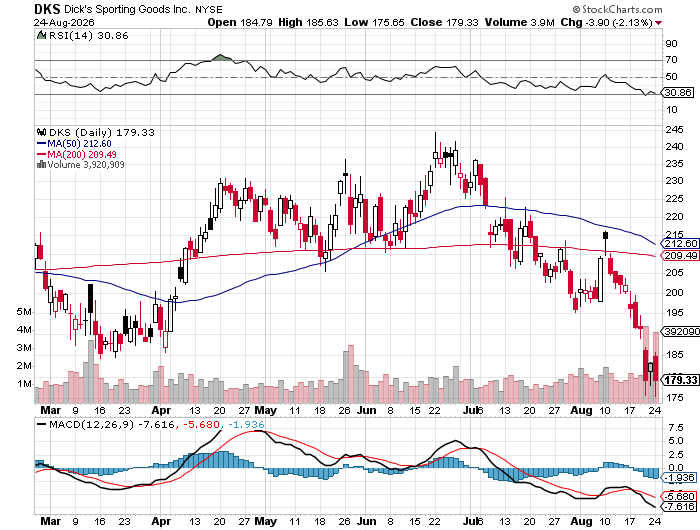
Context matters for how violent this reaction was. DKS closed Monday at $179.33, against a 52-week range of $175.65 to $244.38 — meaning the stock was already sitting within about two percent of its worst level of the year before the report. There was no cushion of accumulated optimism to absorb bad news. A stock that has already de-rated for twelve months does not get graded on a curve; it gets sold. Pre-market quotes sampled through Tuesday morning ranged from roughly $158 down to about $151, a decline somewhere between 12% and 16% depending on the moment, and every one of those prints established a new 52-week low.
Inside the business: two companies in one ticker
Since September 8, 2025, when DICK’S completed its acquisition of Foot Locker, this has effectively been two retailers reporting under one symbol, and they are moving in opposite directions. The company now reports them as two distinct businesses, which is unusually honest and makes the divergence impossible to hide.
The DICK’S business is working. It comped up 4.9% in the quarter on what the company described as broad-based growth across categories, with a specific lift from FIFA World Cup demand. Year to date it is comping up 5.4%. It runs 892 stores, and the growth inside that base is concentrated in newer experiential formats: House of Sport reached 41 locations from 35 a year ago, and Field House grew to 52 from 42 — higher-investment, higher-productivity boxes that give a physical retailer a reason to exist against e-commerce. Management also points to GameChanger, its youth-sports scorekeeping app, and the DICK’S Media Network, its retail advertising arm, as higher-margin businesses attached to the core. For the full year, this half is guided to $14.5 to $14.7 billion in sales with segment profit of $1.54 to $1.60 billion — a margin near 10.7%.
The Foot Locker business is not working. Comparable sales fell 3.6% in the quarter and are down 1.6% year to date. Its store count shrank from 2,561 to 2,478 over the past year, and the closures were deliberate: 20 underperforming Foot Locker North America locations and 44 WSS stores came out of the base. The full-year outlook for this half is $7.4 to $7.5 billion in sales, comparable sales of −2.0% to flat, and — this is the number that stings — a segment loss of $40 million to $80 million. DICK’S paid roughly $2.4 billion in equity value for an asset that will not turn a segment profit in its first full year of ownership.
The explanation management offered is structural rather than excuse-making. Executive Chairman Ed Stack characterized the athletic footwear and apparel market as unusually promotional, and noted that Foot Locker is disproportionately exposed to that pressure because its assortment leans on legacy footwear silhouettes and launch product — exactly the merchandise that gets discounted when a sneaker cycle turns. CEO Lauren Hobart framed the DICK’S comp as market-share capture in that same competitive environment. Both are consistent with the margin line: DICK’S is winning share while the category discounts, and Foot Locker is absorbing the discount.
Why the market punished it this hard
Three things compounded. First, this was a double miss, so there was no “we protected margin” consolation. Second, the guidance cut was concentrated in profit rather than sales: trimming $200 million off the revenue outlook while taking $250 million out of operating income tells investors the problem is margin structure, not just demand. Third, and most damaging, the cut landed specifically on the acquisition. The Foot Locker deal was sold to shareholders as a growth and scale story; guiding that business to a full-year loss, eleven months in, invites the question of whether the price paid was right.
Inventory is worth a footnote. Consolidated inventory stood at $5.565 billion, up 63% year over year — mostly the mechanical effect of consolidating Foot Locker onto the balance sheet. More usefully, DICK’S own inventory rose about 6% against a 4.9% comp. Discipline at the core is intact; the open question is what the acquired inventory is worth in a promotional market.
The bear case and what to watch
The bear case is that DICK’S bought a turnaround and priced it as a growth asset. Foot Locker’s comps are negative, its store base is contracting, it is guided to lose money this year, and the athletic footwear cycle that is pressuring it is outside management’s control. Every quarter that Foot Locker stays negative is a quarter in which the healthy DICK’S business subsidizes it, and consolidated margins stay compressed. Integration costs are real and front-loaded, and the company itself had flagged this quarter as the period of most significant pressure — a warning that, in hindsight, the market did not fully price.
The bull case is not empty. The core chain is comping near 5%, taking share, guided to roughly a 10.7% segment margin, and generating the cash that funds a $5.00 annualized dividend and ongoing buybacks — $141.2 million repurchased year to date. Management is closing weak Foot Locker doors rather than defending them, which is the correct first move in a retail turnaround. And at a pre-market price near $155 against guided non-GAAP EPS of $11.00 to $12.00, the stock trades around 13 to 14 times this year’s own lowered guidance.
What to watch is specific and near-term. First, whether Foot Locker’s comparable sales inflect toward the flat end of that −2.0% to 0.0% guide in the back half; holiday is the test. Second, whether consolidated gross margin stabilizes, because a second consecutive 200-plus basis point contraction would signal the promotional environment is winning. Third, whether the DICK’S banner holds its comp above 2.5% without the World Cup tailwind that helped this quarter. And fourth, whether management cuts guidance again — a company that lowers an outlook twice in a year loses the benefit of the doubt on the third.
The bottom line
DICK’S is running one very good retailer and one struggling one, and for now they are stapled together. The quarter confirmed both halves: a 4.9% comp and share gains at the core, a 3.6% comp decline and a guided full-year loss at Foot Locker. The double-digit reaction was not an overreaction to a small miss — it was a repricing of the acquisition thesis, delivered to a stock already at the bottom of its range with nothing left to give back. Whether this is an opportunity or a value trap depends on a sneaker cycle management does not control and a turnaround that has not yet shown its first positive quarter. The core business earns the benefit of the doubt. The acquisition has not earned it yet.
Get the next Top Stock Pick in your inbox — free.
Recent Top Stock Picks
- NAPCO’s Record Quarter Sent It Up 21% – But Check Which Nine Cents Did the Work
- Moderna Just Cleared the Bar That No mRNA Cancer Therapy Ever Had
- VWAV Stock: VisionWave Rips 45% on Volume Into Aug 20 Earnings — The Defense-AI Micro-Cap Traders Are Watching
- JFB Stock: Inside the XTEND AI-Robotics Merger Turning a Construction Ticker Into an Autonomous-Defense Play
This report is for information purposes only, and is neither a solicitation or recommendation to buy nor an offer to sell securities. TopStockPicks.co is not a registered investment advisor and is not a broker-dealer. TopStockPicks.co has NOT BEEN COMPENSATED for coverage of DKS. TopStockPicks.co and its affiliates or officers may buy and sell shares of DKS in the open market at any time without notice. TopStockPicks.co does not set price targets on securities. Always do your own due diligence and consult your financial advisor. Never invest into a stock discussed by TopStockPicks.co unless you can afford to lose your entire investment.