J.B. Hunt beat on both lines and its intermodal engine grew 22%. For a company that physically moves the economy, a clean quarter is a data point about a lot more than one stock.
There is a reason freight companies get watched far beyond their own shareholders: they move the actual economy. When a business that hauls a meaningful slice of America’s containers and truckloads reports a strong quarter, it is quietly telling you that goods are still moving, shippers are still spending, and the industrial engine has not stalled. So when $JBHT jumped almost 8% after its second-quarter print, the number mattered twice — once for the company, and once as a read on the freight cycle itself. The results were covered in detail by Yahoo Finance and in the company’s own SEC filing.
This profile breaks down what J.B. Hunt reported, why the intermodal number is the one that matters, how the business is actually built, and the reason a great quarter still comes with a real caution attached.
Company snapshot
- Company: J.B. Hunt Transport Services · Ticker: JBHT (NASDAQ)
- Sector: Industrials · Freight & logistics
- Headquarters: Lowell, Arkansas · Founded 1961 by Johnnie Bryan Hunt and Johnelle Hunt
- CEO: Shelley Simpson (president & chief executive)
- Main businesses: Intermodal (rail + drayage), Dedicated Contract Services, brokerage, final mile, and truckload
- Flagship: Intermodal — moving containers by rail, then truck for the final leg
Snapshot figures are widely reported company facts; the Q2 results are sourced below.
Get tomorrow’s pick before the bell — free.
Top Stock Picks lands the day’s biggest market story in your inbox every trading day. No cost, no spam, unsubscribe anytime.
Subscribe free →What actually happened
J.B. Hunt reported second-quarter 2026 results and cleared expectations on both of the lines that count. Earnings came in at $1.91 per diluted share against a Street estimate of roughly $1.74 — a clear beat. Revenue was $3.5 billion versus about $3.25 billion expected — a second beat. Both figures were meaningfully higher than a year earlier, when the company earned $1.31 on $2.93 billion of revenue. In a freight market that spent much of the prior two years in a downturn, growth of that shape is not something the market was fully braced for, which is why the stock reacted the way it did.
The move was immediate: shares climbed as much as 9.5% in the session and settled up about 7.7% from the prior close near $276, adding more than twenty dollars a share. Susquehanna responded by raising its price target on the stock to $326 from $290.

The numbers that moved it
| Metric | Q2 2026 | Street / prior year |
|---|---|---|
| Diluted EPS | $1.91 | $1.74 est. · $1.31 a year ago |
| Revenue | $3.5B | $3.25B est. · $2.93B a year ago |
| Operating income | $259.5M | +32% from $197.3M |
| Intermodal revenue | $1.75B | +22% year over year |
| Stock reaction | ~$276 → ~$297 | +7.7% (intraday +9.5%) |
| Susquehanna target | $326 | raised from $290 |
Sources: J.B. Hunt Q2 2026 release (SEC 8-K), Yahoo Finance, Investing.com earnings transcript, Susquehanna via Defense World. Figures as reported.
The line that anchors the story is operating income up 32% on revenue up far less than that. That gap between revenue growth and profit growth is operating leverage — the business getting more profitable per dollar of sales as volumes recover and the network fills back up. It is the single most encouraging number in the release, because it is durable in a way a one-time gain is not.
Six months of tape
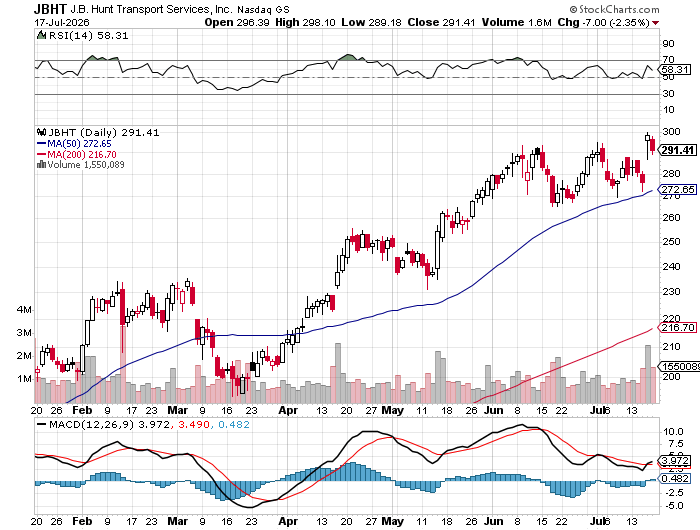
The chart matters here because freight stocks trade the cycle, not the quarter. J.B. Hunt spent much of the past two years working through a freight recession — soft volumes, soft pricing, a market with too many trucks and not enough loads. This beat is the clearest sign yet that the trough is behind it. Whether the tape treats it as the start of an up-cycle or a single good print is the whole question for the stock from here.
Inside the business: how J.B. Hunt actually makes money
J.B. Hunt is not a trucking company in the way most people picture one. It runs several distinct businesses, and the mix is the point.
Intermodal is the flagship and the star of this quarter. The idea is simple and powerful: put a shipping container on a railroad for the long-haul middle of a journey, where rail is cheaper and more fuel-efficient than a truck, then use trucks only for the short first and final legs. J.B. Hunt is one of the largest intermodal operators in North America, and this segment growing 22% to $1.75 billion is the engine that carried the whole result. When intermodal volumes rise, it usually means shippers are moving more goods and are confident enough to plan longer routes.
Dedicated Contract Services is the steady one: J.B. Hunt runs private fleets on behalf of large customers under multi-year contracts. It is less exciting than intermodal but far more predictable, and it smooths the cycle when spot freight markets swing. Brokerage and final mile round out the network — matching shippers with capacity, and handling the big-and-bulky home deliveries that e-commerce created. And the truckload business does exactly what it sounds like.
The reason this structure matters: the pieces do not all move together. Dedicated contracts hold up when spot markets fall; intermodal accelerates when the economy runs. A quarter where intermodal leads is a quarter where the broad freight economy is improving, and that is what makes this print a signal and not just a number.
Why the market rewarded it
Three things drove the reaction. First, the beat was clean and broad — both revenue and earnings cleared, with no “beat on cost cuts, missed on demand” caveat. Second, the growth was led by intermodal, the most economically-sensitive part of the business, which reads as a genuine demand recovery rather than a pricing trick. Third, the 32% jump in operating income showed the recovery dropping through to profit, which is what convinces analysts to raise targets rather than just nod along.
There is a cycle story underneath it, too. After a long freight downturn, investors have been waiting for the first hard evidence that the trough has passed. A bellwether beating on volume growth is exactly that kind of evidence, and money looking to position for a freight recovery now has a name and a number to point at.
The case for caution
The most important thing to understand before chasing this: freight is one of the most cyclical corners of the market, and J.B. Hunt is not a cheap stock. It trades at a rich earnings multiple precisely because investors expect a recovery — which means a good chunk of the good news is already priced in. Paying up for a cyclical after it has already popped is the classic way to be right about the company and wrong about the entry.
The other watch-item is durability. One strong quarter after a downturn can be the start of an up-cycle or a single bounce in a choppy recovery. Freight demand tracks the real economy, so any slowdown in industrial activity or consumer spending would hit these volumes directly. And the stock now carries the weight of expectations: after a beat, a raise in the analyst community, and an 8% pop, the bar for the next quarter just went up.
None of that makes the quarter less real. It just means the quarter and the price are two different questions, and today the quarter is the easy one.
What to watch next
The immediate tell is whether JBHT holds the gap. A cyclical that gives back its entire earnings pop within a week is the market signaling doubt about the recovery’s staying power; a stock that consolidates and builds is the market endorsing it. Beyond the tape, the number to track next quarter is intermodal volume growth — if it holds or accelerates, the up-cycle thesis strengthens; if it fades, this was a bounce. And because freight is a read on the whole economy, watch the broader industrial and retail data: J.B. Hunt’s containers do not fill unless the country is buying and building.
The bottom line
J.B. Hunt delivered a clean beat, grew its most important business by 22%, and turned a modest revenue gain into a 32% jump in operating profit — the kind of operating leverage that says a downturn is ending, not just pausing. For a company that moves the physical economy, that is a signal worth more than one stock’s reaction. The catch is timing: freight is deeply cyclical, the valuation already assumes a recovery, and the stock popped before you read this. If you are looking for evidence the freight cycle has turned, this quarter is it. If you are looking to buy that recovery cheap, the market got there first.
Don’t miss the next one.
Every trading day we break down the market’s biggest story like this. Join free and get it in your inbox before the open.
Subscribe free →Recent Top Stock Picks
This report is for information purposes only, and is neither a solicitation or recommendation to buy nor an offer to sell securities. TopStockPicks.co is not a registered investment advisor and is not a broker-dealer. TopStockPicks.co has NOT BEEN COMPENSATED for coverage of JBHT. TopStockPicks.co and its affiliates or officers may buy and sell shares of JBHT in the open market at any time without notice. TopStockPicks.co does not set price targets on securities. Always do your own due diligence and consult your financial advisor. Never invest into a stock discussed by TopStockPicks.co unless you can afford to lose your entire investment.