Novartis said its oral multiple sclerosis pill beat an established rival in two Phase III trials — and, critically, did it without the liver toxicity that sank the competition. What it did not say was by how much.
There is a particular kind of drug-trial announcement that moves a $290 billion company, and it is rarely the one with the biggest efficacy number. It is the one that removes a fear. Before the bell on September 1, $NVS traded up about 5% in the pre-market, near $159.84 against a prior close of $152.06, after Novartis reported that its oral drug remibrutinib had met the primary endpoint in two late-stage relapsing multiple sclerosis trials. The Swiss-listed line rose about 4.4% to CHF 128.66, close to its 52-week high. The announcement went out over GlobeNewswire, and Investing.com covered the market reaction.
To understand why a mid-single-digit move in a mega-cap pharma is a bigger story than it looks, you have to know what happened to the last company that tried this. This profile walks through what Novartis actually reported, why the safety data matters more than the efficacy data, what the rest of the business looks like underneath, and the several genuine reasons for caution — including one that surfaced eight days ago.
Company snapshot
- Company: Novartis AG · Ticker: NVS (NYSE, ADR)
- Sector: Healthcare · Innovative (branded) pharmaceuticals
- Headquarters: Basel, Switzerland
- Formed: incorporated February 1996; Ciba-Geigy and Sandoz merged into it that December
- CEO: Vas Narasimhan
- Structure: a pure-play innovative medicines business since the Sandoz generics spin-off on October 4, 2023
- Approx. market cap: ~$289.8B · Shares outstanding: ~1.90B
- Valuation / income: P/E ~22.7 · dividend yield ~2.03% ($3.08 annualized)
Snapshot figures are company-reported or widely published facts; price, valuation and volume data are as quoted on the morning of September 1, 2026.
What actually happened
Novartis reported topline results from REMODEL-1 and REMODEL-2, two identically designed Phase III trials of remibrutinib in relapsing multiple sclerosis. Roughly 2,000 patients were randomized 1:1 across the two studies, with a double-blind treatment period running up to 30 months and an open-label extension of up to five years. Enrolled patients had evidence of recent disease activity and an EDSS disability score between 0.0 and 5.5 — in plain terms, people with active disease who are still ambulatory.
Both trials met the primary endpoint: remibrutinib significantly reduced the annualized relapse rate compared with teriflunomide, an established oral MS therapy used as the active comparator. Novartis also said remibrutinib was superior to teriflunomide on all key secondary endpoints within each trial, including reduction of inflammatory MRI brain lesions. On disability — the endpoint the whole field cares most about — the company described a clinically meaningful delay in progression, with a positive trend on three-month confirmed disability progression and a nominally significant result on six-month confirmed disability progression in a preplanned combined analysis of the two studies.
Then the sentence that actually moved the stock: a favorable safety profile with no liver safety signal, including no cases meeting Hy’s Law criteria. Hy’s Law is the regulatory rule of thumb for spotting drugs capable of causing fatal liver injury. Zero cases is the cleanest thing a BTK inhibitor in this indication has been able to say.

The trial at a glance
| Item | REMODEL-1 / REMODEL-2 | Detail |
|---|---|---|
| Drug | Remibrutinib (Rhapsido) | Oral, covalent BTK inhibitor |
| Comparator | Teriflunomide | Established oral MS therapy |
| Enrollment | ~2,000 patients | Randomized 1:1, global |
| Duration | Up to 30 months | Plus open-label extension to 5 years |
| Primary endpoint | Met in both trials | Annualized relapse rate reduction |
| Key secondaries | Superior on all | Includes MRI lesion reduction |
| Liver safety | No signal | No Hy’s Law cases |
| Exact figures | Not disclosed | Held for MSToronto2026 late-breaker |
Source: Novartis topline media release, September 1, 2026. Detailed efficacy data have not yet been published.
Six months of tape
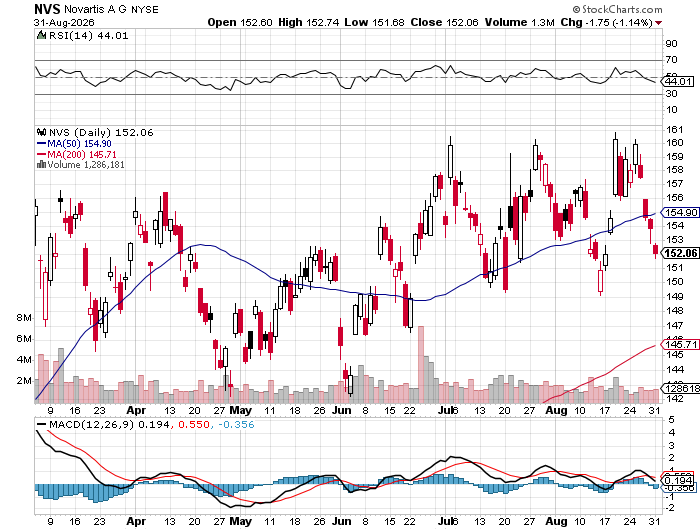
Context matters for how you read a 5% gap in a name this size. Novartis went into this readout as a company the market had already been warming to — Deutsche Bank initiated coverage with a Buy rating in the days just before the data landed, and the Swiss line was trading within a couple of francs of its 52-week high. This was not a broken stock being rescued by a surprise. It was a stock priced for reasonably good news receiving news that was better than good on the one axis nobody was sure about.

Why the liver data is the whole story
BTK inhibitors have been the most anticipated new mechanism in multiple sclerosis for years, because unlike the injected and infused anti-CD20 antibodies that dominate the market, a small molecule pill can cross into the central nervous system and potentially act on the smoldering inflammation that drives disability progression. The problem has never been whether the class works. It has been the liver.
Sanofi acquired tolebrutinib as the centerpiece of its $3.7 billion purchase of Principia Biopharma, and the FDA placed a partial clinical hold on its Phase III MS and myasthenia gravis programs after cases of drug-induced liver injury emerged — halting U.S. enrollment and suspending dosing in patients treated for fewer than 60 days. The problem did not go away. As FierceBiotech reported, the agency ultimately cited a serious risk of severe drug-induced liver injury — six such cases among roughly 2,700 patients — that could not be adequately mitigated by the proposed risk management strategy, and noted the risk of fatal cases appeared to be among the highest in the class.
That is the bar Novartis just cleared. Reporting no liver safety signal and no Hy’s Law cases in a roughly 2,000-patient program is not a footnote — it is the difference between a drug that reaches the market with a clean label and one that does not reach the market at all. It also reframes the class: the liver problem may be a molecule problem rather than a mechanism problem.
Inside the business
Remibrutinib is not a lottery ticket for Novartis; it is an extension of a franchise the company already leads in. Novartis sells Kesimpta, a self-administered subcutaneous anti-CD20 antibody that has become the clearest challenger to Roche’s Ocrevus, the category’s long-standing leader. Roche reported $7.6 billion in Ocrevus sales in 2024. The broader multiple sclerosis therapy market was valued at roughly $21.8 billion in 2025.
Remibrutinib is also already an approved medicine. It is marketed as Rhapsido, cleared by the FDA in September 2025 and by the EMA in April 2026 for chronic spontaneous urticaria — a chronic hives condition. That matters commercially and clinically: the company has real-world safety experience with the molecule in another indication, and Novartis explicitly described the MS safety profile as consistent with what it has seen in urticaria.
The rest of the business is doing well. In the second quarter of 2026, Novartis reported net sales of $14.4 billion, up 1% in constant currency and ahead of consensus of roughly $13.7 billion, and reaffirmed full-year guidance. The growth brands are carrying it: Kesimpta rose 32% to $1.4 billion, Kisqali grew 55% in constant currency to $1.5 billion, Pluvicto grew 70% to $642 million, and Scemblix grew 79% to $433 million.
The case for caution
Four things deserve to sit alongside the good news.
First, there are no numbers. Novartis disclosed direction, not magnitude. It has not released the actual annualized relapse rates, the effect size versus teriflunomide, or p-values, holding them for a late-breaking presentation at the MSToronto2026 congress. Investors buying this move are buying a press release, not a data set. Superiority over teriflunomide is a real result, but teriflunomide is a moderate-efficacy comparator — beating it does not by itself establish that remibrutinib competes with the high-efficacy anti-CD20 drugs that define the market. Until the curves are public, the commercial ceiling is genuinely unknown.
Second, eight days ago Novartis had a very bad safety headline of its own. On August 24 the company paused eight clinical trials of rap-cel, an experimental CAR-T cell therapy for autoimmune and neurological conditions, after three patient deaths. As BioPharma Dive and Endpoints News reported, the deaths followed severe immune effector cell-associated hemophagocytic syndrome, a known and potentially life-threatening complication of CAR-T therapy; Bristol Myers Squibb paused related programs as well. The affected trials spanned lupus, rheumatoid arthritis, vasculitis, myasthenia gravis — and multiple sclerosis. Novartis said it is conducting a comprehensive review with independent safety boards. The market chose to weigh today’s readout as the more material event, but that is a judgment, not a fact.
Third, the patent cliff is the real story running underneath everything. Entresto, the heart-failure blockbuster, saw sales fall 51% year over year to $1.18 billion in the second quarter as U.S. generics arrived, and it loses European exclusivity in 2028. Cosentyx follows in 2029, and both Kesimpta and Kisqali in 2031. Novartis is facing one of the steeper patent expiry schedules in large-cap pharma, and the entire investment case rests on whether the pipeline refills the hole faster than it opens.
Fourth, some of this success competes with itself. A convenient, high-efficacy oral MS drug is a threat to injected anti-CD20 therapy — and Novartis owns one of those. Kesimpta is a $1.4-billion-a-quarter product growing 32%. A meaningful share of remibrutinib’s eventual revenue may come out of Novartis’s own franchise rather than Roche’s, which makes the net addition to group sales smaller than the headline opportunity suggests.
What to watch next
The first real checkpoint is the MSToronto2026 presentation, where the withheld numbers become public. Watch the annualized relapse rate reduction against teriflunomide and, more importantly, the confirmed disability progression curves — the six-month result was described as nominally significant in a combined analysis, which is a carefully hedged phrase and will be scrutinized as such. After that, watch for the regulatory submissions Novartis says it plans to file globally, and watch the rap-cel review for whether the pause becomes a discontinuation. On the tape, the simple tell is whether NVS holds this gap after the open or gives it back once the absence of hard data sinks in.
The bottom line
Novartis cleared the exact hurdle that has defined this drug class, and it did so in the indication where the prize is largest. Two Phase III trials hit their primary endpoint, every key secondary endpoint went the right way, and the liver safety profile that ended a competitor’s program came back clean. That is a genuinely good day for a company that needs pipeline wins to offset a heavy patent cliff, and the market’s roughly 5% response looks proportionate rather than euphoric. But the release is a claim of victory without the scoreboard: no effect sizes, no p-values, a moderate-efficacy comparator, and a serious safety pause in another program still unresolved eight days on. This is a real catalyst in a real franchise, and it is also a pre-market move on incomplete information — pre-market moves can and do reverse at the open. The data that decides how big this actually is has not been shown yet.
Get the next Top Stock Pick in your inbox — free.
Recent Top Stock Picks
This report is for information purposes only, and is neither a solicitation or recommendation to buy nor an offer to sell securities. TopStockPicks.co is not a registered investment advisor and is not a broker-dealer. TopStockPicks.co has NOT BEEN COMPENSATED for coverage of NVS. TopStockPicks.co and its affiliates or officers may buy and sell shares of NVS in the open market at any time without notice. TopStockPicks.co does not set price targets on securities. Always do your own due diligence and consult your financial advisor. Never invest into a stock discussed by TopStockPicks.co unless you can afford to lose your entire investment.