Lockheed Martin beat on earnings, raised its full-year outlook, and pushed its order backlog to a record $230 billion. For the world’s largest defense contractor, this was a quarter that showed demand — and cash flow — accelerating.
When the biggest defense company on earth beats expectations and raises its outlook and reports a record backlog all in the same quarter, the market notices. On July 23, $LMT — Lockheed Martin — did exactly that, and the stock jumped about 6% in response. Second-quarter earnings came in at $7.94 per share against a Street estimate near $7.19, on $20.1 billion of sales, and management lifted its full-year guidance. The results were detailed in the company’s Q2 2026 release and covered across the financial press.
Lockheed Martin is a bellwether for global defense spending, and this quarter it sent an unambiguous signal: demand is strong, the order book is at a record, and the cash is now flowing. This profile breaks down what Lockheed reported, why the backlog is the number that matters most, how the business is built, and what to watch from here.
Company snapshot
- Company: Lockheed Martin · Ticker: LMT (NYSE)
- Sector: Industrials · Aerospace & defense
- Headquarters: Bethesda, Maryland · the world’s largest defense contractor
- Chair & CEO: Jim Taiclet
- Segments: Aeronautics (incl. the F-35), Missiles & Fire Control, Rotary & Mission Systems (incl. Sikorsky), and Space
- The backdrop: Rising global defense budgets and elevated demand for missiles and air defense
Snapshot figures are widely reported company facts; the Q2 results are sourced below.
What actually happened
Lockheed delivered a broad, clean beat. Sales rose to $20.1 billion from $18.2 billion a year earlier, and net earnings were $1.8 billion, or $7.94 per share — comfortably ahead of the roughly $7.19 analysts expected. The strength was described as broad-based across the defense businesses, with a notable surge in missile production. On the back of it, the company raised its full-year 2026 guidance to $29.95–$30.65 in EPS on sales of $79.75–$81.75 billion, up from prior ranges of $29.35–$30.25 and $77.50–$80.00 billion.
Two figures underneath the headline made the quarter stand out even more: the backlog and the cash. The backlog — work already under contract but not yet delivered — hit a record $230 billion after the company booked $65 billion of new orders in the quarter. And cash generation swung dramatically: free cash flow was $2.9 billion, versus negative $150 million a year ago.
The numbers that moved it
| Metric | Q2 2026 | Context |
|---|---|---|
| EPS | $7.94 | beat ~$7.19 est. |
| Sales | $20.1B | up from $18.2B a year ago |
| Backlog | $230B (record) | $65B new orders booked |
| Free cash flow | $2.9B | vs −$150M a year ago |
| Cash from operations | $3.2B | vs $201M a year ago |
| FY26 EPS guidance | $29.95–$30.65 | raised from $29.35–$30.25 |
Sources: Lockheed Martin Q2 2026 release (PR Newswire), Seeking Alpha, RTTNews, CNBC. Figures as reported.
The record $230 billion backlog is the single most important line. Backlog is future revenue that is already contracted, and a record level gives Lockheed years of demand visibility — a rare luxury in most industries. It is the clearest evidence that the current wave of defense spending is translating into real, signed orders rather than just headlines.
Six months of tape
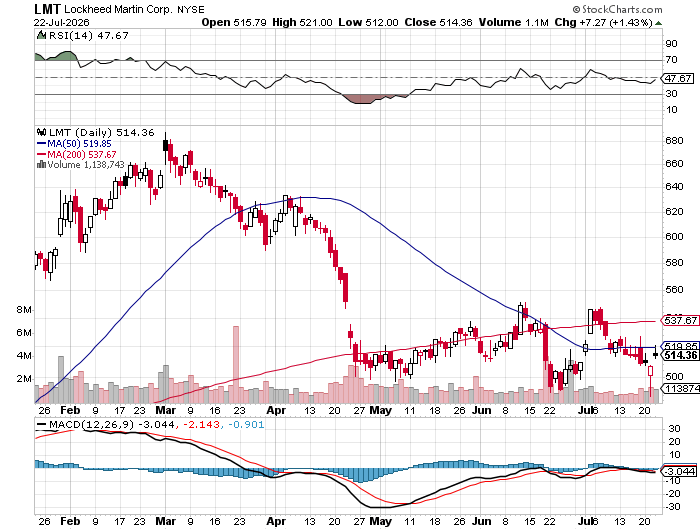
Defense stocks trade on the intersection of geopolitics and execution, and Lockheed sits at the center of both. A quarter that pairs a beat and a guidance raise with a record backlog and a sharp turn in cash flow is the kind of print that reinforces a long-term thesis rather than merely satisfying a single quarter’s expectations.
Inside the business: how Lockheed makes money
Lockheed Martin runs four large segments, each anchored by flagship programs. Aeronautics is home to the F-35 fighter, the company’s single largest program and a decades-long franchise. Missiles & Fire Control — the standout this quarter — builds precision missiles and air-defense systems, exactly the products in highest demand as nations rebuild stockpiles and invest in air defense. Rotary & Mission Systems includes Sikorsky helicopters and a range of naval and mission-systems work, and Space covers satellites, missile-warning systems, and related programs.
The strength of the model is its visibility: Lockheed sells primarily to the U.S. government and allied nations under long, multi-year contracts. That is what produces a backlog measured in hundreds of billions and revenue that is unusually predictable. The surge in missile production this quarter is a direct readout of where defense dollars are flowing right now.
Why this quarter matters
Three things stand out. First, the beat was broad-based, not reliant on a single program, which speaks to healthy demand across the whole portfolio. Second, the guidance raise signals management’s confidence that the momentum continues through the year. Third, and most striking, the cash-flow swing — from negative free cash flow a year ago to $2.9 billion this quarter — shows the business converting its record order book into real cash, which funds the dividends and buybacks that defense investors prize. Together they describe a company benefiting from a powerful, durable spending cycle and executing well against it.
Keeping it real
One honest note, because every stock has a flip side: Lockheed’s revenue depends heavily on government budgets and geopolitics. Defense spending is elevated now, but it is set by politics, and budget priorities or program decisions can shift. Program-specific risks (the F-35, for instance, is always scrutinized) are part of the picture too, and the stock moved up on this news, so some of the good quarter is now in the price. None of that undercuts the results — it just means Lockheed is a defense stock, and defense stocks live with policy risk as the trade-off for their remarkable visibility.
What to watch next
From here, the signals that matter are concrete: whether the backlog keeps climbing (new orders each quarter), whether the missile-production surge sustains as nations restock, and whether the strong free cash flow holds and funds continued capital returns. Because Lockheed is a bellwether for global defense, its order book also reads as a real-world gauge of how much the world is spending on security — and right now, that gauge is at a record.
The bottom line
Lockheed Martin beat, raised its full-year outlook, booked $65 billion of new orders to push its backlog to a record $230 billion, and swung to $2.9 billion of free cash flow — a quarter that showed both demand and cash accelerating together. As the largest defense contractor in the world, it is a direct beneficiary of a global spending cycle that shows no sign of slowing. It carries the policy risk every defense name does, and it has already run on the news — but this was the kind of quarter that makes the long-term case louder.
Get the next Top Stock Pick in your inbox — free.
Recent Top Stock Picks
- GE Vernova Just Nearly Doubled Its Cash-Flow Outlook — and a $176B Backlog Shows Why
- General Motors Just Raised Its Outlook Again — and the EV Math Is Finally Turning
- VisionWave: A Bold Up-and-Comer Riding the Defense-Autonomy Wave
- Hut 8 Just Finished Filling a Billion Watts: A Second $9.8B Lease Completes Its Texas AI Campus
This report is for information purposes only, and is neither a solicitation or recommendation to buy nor an offer to sell securities. TopStockPicks.co is not a registered investment advisor and is not a broker-dealer. TopStockPicks.co has NOT BEEN COMPENSATED for coverage of LMT. TopStockPicks.co and its affiliates or officers may buy and sell shares of LMT in the open market at any time without notice. TopStockPicks.co does not set price targets on securities. Always do your own due diligence and consult your financial advisor. Never invest into a stock discussed by TopStockPicks.co unless you can afford to lose your entire investment.