General Motors beat on earnings, raised its full-year profit outlook for the second time this year, and — maybe most importantly — showed its electric-vehicle losses narrowing. For an American icon, this was a quarter that said the turnaround is working.
When a company the size of $GM raises its guidance twice in a single year, it is worth paying attention — big, established businesses do not upgrade their outlook casually. On July 21, General Motors reported second-quarter 2026 results that cleared Wall Street’s earnings bar and, more tellingly, gave management the confidence to lift full-year expectations again. Earnings came in at $3.57 per share against a $3.29 estimate, and the company raised its 2026 profit guidance for the second time this year. The results are detailed in GM’s Q2 2026 release and were covered widely across the financial press.
This is the profile of a legacy automaker executing well in a hard environment — holding pricing, controlling costs, and finally bending the cost curve on the part of the business that has worried investors most: electric vehicles. Here is what GM reported, why the guidance raise matters, how the business actually makes money, and what to watch from here.
Company snapshot
- Company: General Motors · Ticker: GM (NYSE)
- Sector: Consumer cyclical · Automotive manufacturing
- Headquarters: Detroit, Michigan · Founded 1908
- Chair & CEO: Mary Barra
- Brands: Chevrolet, GMC, Buick, Cadillac — plus the Ultium EV platform, BrightDrop commercial vehicles, and Cruise autonomous technology
- Scale: ~$68B market cap · ~$48B in quarterly revenue
Snapshot figures are widely reported company facts; the Q2 results are sourced below.
What actually happened
GM delivered a clean earnings beat. Second-quarter EPS of $3.57 topped the $3.29 analysts were modeling, a beat of 28 cents. Revenue came in at $48.0 billion, net income attributable to stockholders was $1.3 billion, and EBIT-adjusted — the profit measure the company emphasizes — was $3.9 billion. Revenue landed just shy of the highest estimates, but the profitability and the outlook were the story, and both pointed up.
The headline move was the guidance. GM raised its full-year 2026 EBIT-adjusted outlook for the second time this year, now guiding to net income of roughly $8.4 billion to $9.8 billion, diluted EPS of about $8.98 to $10.98, and automotive operating cash flow of $15.4 billion to $19.4 billion. A second raise in a single year is a strong signal of momentum.
The numbers that moved it
| Metric | Q2 2026 | Context |
|---|---|---|
| Diluted EPS | $3.57 | beat $3.29 est. by $0.28 |
| Revenue | $48.0B | slightly below the highest estimates |
| EBIT-adjusted | $3.9B | core profit measure |
| Net income | $1.3B | attributable to stockholders |
| FY26 EPS guidance | ~$8.98–$10.98 | raised 2nd time this year |
| FY26 auto op. cash flow | $15.4–$19.4B | strong cash generation |
Sources: GM Q2 2026 release (SEC 8-K), CNBC, GuruFocus, Quartz. Figures as reported.
The single most encouraging item is not in the headline numbers at all: the drivers behind the beat. Management pointed to steady vehicle transaction prices, lower warranty costs, and — the one investors have waited years for — narrowing losses on electric vehicles. When those move in the right direction together, a guidance raise follows naturally.
Six months of tape
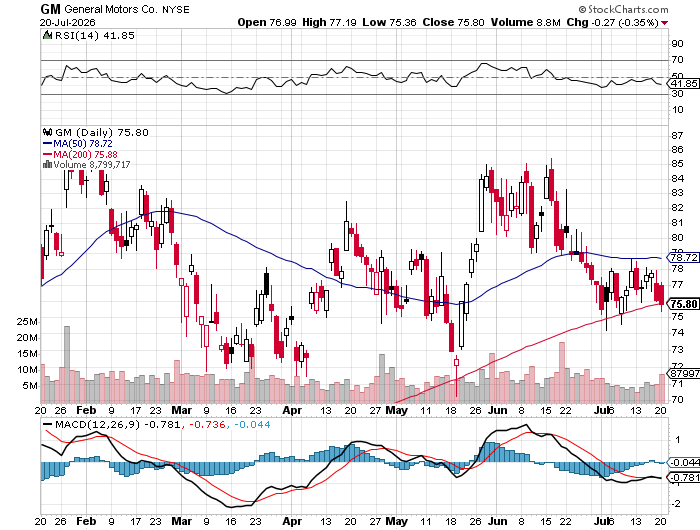
GM has been one of the more debated large-caps in the market — caught between a strong, cash-generative truck franchise and the heavy investment demanded by the EV transition. A quarter that shows the profitable core holding up and the EV drag easing is exactly the kind of print that can shift the narrative from “value trap” to “improving story.”
Inside the business: how GM makes money
The heart of GM is North America, and the heart of North America is trucks and SUVs. The Chevrolet Silverado, GMC Sierra, and the full-size SUVs and crossovers are the profit engine — high-margin vehicles that fund everything else. That franchise generated the bulk of this quarter’s strength, helped by pricing that has stayed firmer than many expected.
Around that core, GM is building the future in three pieces. The Ultium platform is its scalable EV architecture, and the narrowing losses there are the sign that scale and cost discipline are starting to work. BrightDrop targets the fast-growing commercial and delivery-vehicle market. And Cruise is its bet on autonomous technology. The point of the structure is balance: a highly profitable traditional business throwing off cash to fund the transition, rather than betting the company on any single technology before it pays.
Why this quarter matters
Three things make it stand out. First, the beat was driven by fundamentals investors trust — pricing and cost control, not one-off items. Second, the second guidance raise of the year signals that management sees the momentum continuing, not fading. Third, and most important for the long-term story, the EV losses are shrinking. For years the bear case on GM was that electric vehicles would be a bottomless investment; evidence that the economics are improving directly attacks that argument. Put together, it is a picture of a company executing on both halves of a difficult balancing act at once.
Keeping it real
One honest note, because good analysis needs it: revenue came in a touch below the highest estimates, and the auto industry is deeply cyclical — sales track the economy, interest rates, and consumer confidence, all of which can turn. Tariffs and the pace of the EV transition remain real variables. None of that erases a strong quarter; it just means GM is a cyclical, and cyclicals are best bought with eyes open to the cycle.
What to watch next
The signals that would confirm the story from here: whether the EV losses keep narrowing quarter over quarter (the single most important trend), whether pricing and transaction values hold as the year progresses, and whether GM converts its strong guided cash flow into continued buybacks and investment. Because GM is a bellwether for the American consumer’s big-ticket spending, its results also read as a broader signal — and right now that signal is encouraging.
The bottom line
General Motors delivered a clean beat, raised its full-year outlook for the second time this year, and showed its EV losses narrowing — the exact combination the bull case needed. The profitable truck-and-SUV core is doing its job, and the part of the business that worried investors most is trending the right way. It remains a cyclical, and the ride can be bumpy, but this was a quarter that said GM’s turnaround is working — and that management has the confidence to say so out loud, twice.
Get the next Top Stock Pick in your inbox — free.
Recent Top Stock Picks
- VisionWave: A Bold Up-and-Comer Riding the Defense-Autonomy Wave
- Hut 8 Just Finished Filling a Billion Watts: A Second $9.8B Lease Completes Its Texas AI Campus
- A 46% Profit Jump at a Dow Insurer — and How Much of It Was Just the Weather
- One of the Market’s Biggest One-Day Moves — and the Analyst Who Still Won’t Chase It
This report is for information purposes only, and is neither a solicitation or recommendation to buy nor an offer to sell securities. TopStockPicks.co is not a registered investment advisor and is not a broker-dealer. TopStockPicks.co has NOT BEEN COMPENSATED for coverage of GM. TopStockPicks.co and its affiliates or officers may buy and sell shares of GM in the open market at any time without notice. TopStockPicks.co does not set price targets on securities. Always do your own due diligence and consult your financial advisor. Never invest into a stock discussed by TopStockPicks.co unless you can afford to lose your entire investment.