Cloudflare’s second quarter did the one thing a high-multiple software stock has to do: it accelerated. Revenue grew 36%, the biggest customers spent meaningfully more, and management raised the full-year outlook. Shares jumped roughly 16% pre-market.
Expectations were already high going into this print — $NET was sitting near a record high, and analysts had been raising price targets into the event. Cloudflare cleared the bar anyway. The company reported second-quarter revenue of $696.1 million, up 36% year over year, non-GAAP earnings of $0.29 per share, a dollar-based net retention rate of 120%, and a raised full-year revenue forecast of roughly $2.86 to $2.87 billion. The stock, which had closed down about 3% at $284.43 on Thursday, was quoted around $329 in Friday’s pre-market. The results came from Cloudflare’s Q2 2026 earnings release, with coverage from Seeking Alpha, Benzinga and StockStory.
Cloudflare is one of those companies most people use every day without ever seeing. It sits between internet users and the websites and applications they visit, making them faster and defending them from attack. This profile walks through what the quarter actually showed, how the business earns money, why the market re-rated the stock on the news — and the genuinely uncomfortable parts of the report that the headline number does not capture.
Company snapshot
- Company: Cloudflare, Inc. · Ticker: NET (NYSE)
- Sector: Technology · Cloud infrastructure, cybersecurity and edge computing
- Founded: July 26, 2009 by Matthew Prince, Lee Holloway and Michelle Zatlyn; headquartered in San Francisco, California
- Went public: September 2019, on the New York Stock Exchange
- Leadership: Co-founder Matthew Prince is chief executive officer
- What it does: Operates a global network that acts as a reverse proxy in front of customers’ websites and applications — speeding up delivery, absorbing attacks, and increasingly running code and AI workloads at the edge
- Scale: Cloudflare’s network spans more than 300 cities worldwide
Snapshot items are widely reported company facts; the Q2 results are sourced below.
What actually happened
Cloudflare reported second-quarter 2026 results after the closing bell on Thursday, August 6. Revenue came in at $696.1 million, a 36% increase from the same quarter a year earlier and ahead of the roughly $665 million analysts had modeled. On a non-GAAP basis, the company earned $0.29 per diluted share, up from $0.21 a year ago and above the $0.27 consensus. Current remaining performance obligations — a forward-looking measure of contracted revenue expected to be recognized over the next twelve months — grew 35% year over year, closely tracking reported growth.
The customer detail was arguably the stronger part of the release. Cloudflare finished the quarter with 4,698 large customers, defined as those paying more than $100,000 a year, a 27% increase from a year ago. It added 282 of them during the quarter, and 986 over the trailing twelve months — the most it has ever added in a year. Those large accounts now generate 73% of total revenue, up from 71% a year earlier. Critically, the dollar-based net retention rate — which measures how much more existing customers spend versus a year ago — accelerated to 120%, up two points sequentially and six points year over year. A retention rate moving that direction means the installed base is expanding faster, not just that new logos are arriving.
Then came the guidance. Management raised the full-year 2026 revenue outlook to a range of $2,864 million to $2,870 million, against a prior consensus near $2.81 billion, and lifted full-year non-GAAP earnings guidance to $1.25 to $1.26 per share versus roughly $1.21 expected. For the current quarter, the company guided to revenue of $736.0 million to $737.0 million and non-GAAP earnings of $0.34 per share — both above the Street. A beat paired with a raise, on accelerating growth, is the combination that moves a stock like this.
The numbers that moved it
| Metric | Q2 2026 | Context |
|---|---|---|
| Revenue | $696.1M | +36% YoY; vs ~$665M est. |
| Non-GAAP EPS | $0.29 | vs $0.21 YoY; ~vs $0.27 est. |
| GAAP EPS | ($0.48) | vs ($0.15) a year ago |
| Non-GAAP gross margin | 73.1% | down 320bps YoY; up 30bps QoQ |
| Non-GAAP operating margin | 13.8% | vs 14.1% YoY |
| Operating cash flow | $117.6M | free cash flow $56.4M (8% of revenue) |
| Large customers (>$100k) | 4,698 | +27% YoY; 73% of revenue |
| Net retention rate | 120% | +6 pts YoY |
| Q3 revenue guide | $736.0–737.0M | above consensus |
| FY26 revenue guide | $2,864–2,870M | raised; vs ~$2.81B prior est. |
| Stock reaction | ~+16% pre-market | after closing $284.43 (−2.91%) |
Sources: Cloudflare Q2 2026 release (Business Wire), StockTitan, Seeking Alpha, StockStory, Benzinga, stockanalysis.com. Figures as reported.
Six months of tape
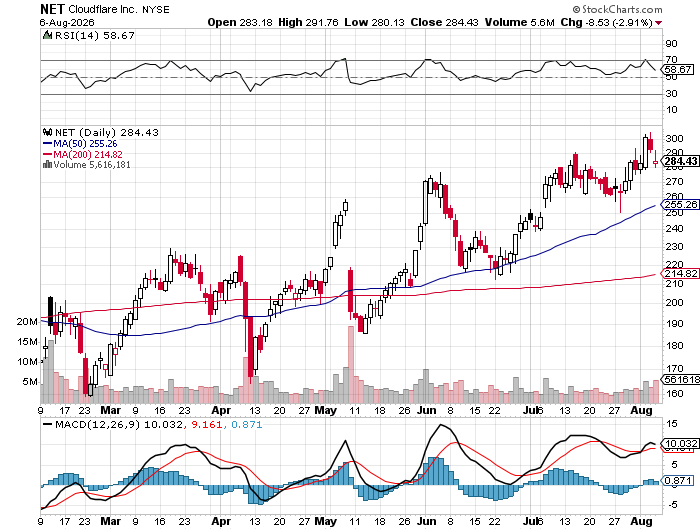
Context matters on this chart. Cloudflare did not gap higher from a depressed base — it gapped higher from an already-elevated one, having been one of 2026’s better-performing infrastructure names. That cuts both ways: it confirms the market’s conviction in the story, and it means the valuation cushion is thin.

Inside the business: how Cloudflare makes money
Cloudflare sells subscriptions to a single, unified global network. Every server in every location can, in principle, run every service the company offers — a design choice that keeps incremental costs down and lets Cloudflare add products without building separate infrastructure for each one.
The offering spans three broad areas. The oldest is application performance and delivery: the content delivery network and DNS services that cache content close to users and route traffic efficiently, including the widely used 1.1.1.1 public resolver. The second is security: DDoS mitigation, a web application firewall, bot management, email security, and the Zero Trust access products sold under the Cloudflare One banner, which replace traditional corporate VPNs by verifying every user and every request rather than trusting anything inside a network perimeter. The third, and fastest-growing, is the developer platform: Cloudflare Workers, a serverless computing environment that runs customer code at the edge, along with R2 object storage and Workers AI for running models on Cloudflare’s own network.
The commercial logic is land-and-expand. A company might arrive for DDoS protection and stay to buy Zero Trust access, then start running workloads on Workers. That is precisely what a 120% net retention rate describes: the average existing customer is spending 20% more than a year ago, before any new customers are counted. It is also why the large-customer count matters more than the raw customer number — the enterprise accounts are where multi-product expansion actually happens.
Why it moved
Three things did the work. First, growth accelerated rather than merely holding: 36% is a faster rate than the company posted in the prior quarter, which is unusual at this revenue scale and is exactly what a premium multiple is supposed to be paying for. Second, the net retention acceleration to 120% suggests the AI-era product cycle is translating into real spending, not just interest. Third, management raised full-year guidance on both revenue and earnings rather than simply passing through the beat — a signal of confidence in the second half.
Analysts responded quickly. TD Cowen lifted its price target to $300 from $250 with a Buy rating, Barclays moved to $300 from $250 at Overweight, and BTIG raised its target to $314 from $269, reiterating a Buy.
Keeping it real
The report was strong, but it was not spotless, and the parts that get less attention deserve a fair hearing.
Cloudflare is still unprofitable on a reported basis, and got more so. GAAP loss per share widened to $0.48 from $0.15 a year ago, and the GAAP operating margin fell to negative 29.6% from negative 13.1%. A large part of that is $151 million of severance and restructuring charges booked in the quarter, with roughly $165 million expected for the full year. Restructuring costs are real cash, and the gap between a $0.29 adjusted profit and a $0.48 reported loss is a wide one that investors should look at squarely.
Gross margins are lower than they were. Non-GAAP gross margin of 73.1% is down 320 basis points from 76.3% a year ago, driven by traffic-mix shifts that push more cost into cost of revenue. The encouraging counterpoint is that margin improved 30 basis points sequentially — the first sequential improvement in eight quarters — and management indicated the trend is beginning to stabilize. Still, the direction over the past two years has been down.
Cash generation is modest relative to the valuation. Free cash flow of $56.4 million is about 8% of revenue. Network capital expenditure is guided at 14% to 15% of full-year revenue, so this is a business that must keep spending heavily to grow. Notably, management has deliberately declined to compete in the GPU infrastructure arms race, arguing that selling commodity compute leans on the balance sheet rather than delivering differentiated value — a defensible strategy, but one whose payoff is unproven.
And the valuation leaves little room for error. Roughly $101 billion of market value against about $2.87 billion of guided 2026 revenue is well over 30 times sales, and that was before a 16% move. At that multiple, a single quarter of decelerating growth can be punished severely. The shift toward pool-of-funds and consumption-based contracts also introduces more revenue variability and makes forecasting harder for the company and its analysts alike.
One more practical caution: this was a pre-market quote, not a closing price. Pre-market moves are thin, and they reverse at the open more often than headlines suggest.
What to watch next
The concrete markers from here are straightforward. Does the net retention rate hold at or above 120%, or was this quarter the peak? Does large-customer growth stay near 27% as the comparisons get harder? Does gross margin continue its sequential recovery, confirming that the compression has bottomed? Do the restructuring charges genuinely end this year, closing the gap between adjusted and reported results? And does the developer platform — Workers, R2 and Workers AI — grow into a large enough revenue contributor to justify the AI narrative attached to the stock? The third-quarter report, guided to $736 million or so, is the next checkpoint.
The bottom line
Cloudflare delivered the quarter its valuation demanded: 36% revenue growth that accelerated, a record year of large-customer additions, net retention up six points to 120%, an earnings beat, and raised guidance for both the quarter and the year. That is a genuinely excellent set of results, and the roughly 16% pre-market response is a rational reaction to a company proving its expansion engine is working. The other side is equally real: a widening reported loss, gross margins still below year-ago levels, thin free cash flow against heavy network spending, and a stock priced at more than 30 times sales, which is an unforgiving place to sit if growth wobbles. Cloudflare looks like a high-quality business executing well — carrying expectations that leave almost no margin for a stumble.
Get the next Top Stock Pick in your inbox — free.
Recent Top Stock Picks
- Shopify Just Posted a ‘Monster’ Quarter — 34% Revenue Growth, 32% GMV, and AI Orders Tripling
- Eli Lilly Just Posted a Record $23 Billion Quarter — and Raised Its Outlook as Mounjaro and Zepbound Surge
- Caterpillar Just Booked Its First $20 Billion Quarter — and Data Centers Are Fueling It
- Atkore Is Getting Bought for $3.8 Billion — Shareholders Just Won a 30% Premium
This report is for information purposes only, and is neither a solicitation or recommendation to buy nor an offer to sell securities. TopStockPicks.co is not a registered investment advisor and is not a broker-dealer. TopStockPicks.co has NOT BEEN COMPENSATED for coverage of NET. TopStockPicks.co and its affiliates or officers may buy and sell shares of NET in the open market at any time without notice. TopStockPicks.co does not set price targets on securities. Always do your own due diligence and consult your financial advisor. Never invest into a stock discussed by TopStockPicks.co unless you can afford to lose your entire investment.