Travelers posted a 46% jump in quarterly profit and core earnings that nearly doubled Wall Street’s estimate. It was a genuinely excellent quarter — but a large share of it came from something the company does not control: the weather.
When a 170-year-old Dow insurer beats earnings estimates by nearly double, it is worth stopping to ask why. On Friday, $TRV — The Travelers Companies — rose about 8% after reporting second-quarter results that blew past expectations: net income up 46% from a year earlier, and core earnings per share of $10.04 against a consensus near $5.41. For a large, slow-moving property-casualty insurer, that is a startling beat, and the market rewarded it immediately. The results were detailed in the company’s Q2 2026 release and covered across the financial and trade press.
But insurance earnings are unusual, because a big part of any single quarter is decided by events no management team controls: catastrophes. A quiet storm season makes an average insurer look brilliant; a violent one makes a great insurer look reckless. So the real question with a quarter like this is not just “how big was the beat” but “how much of it is repeatable.” This profile breaks down what Travelers reported, how a P&C insurer actually makes money, why the market cheered, and the one number that should keep anyone from extrapolating this quarter straight into the future.
Company snapshot
- Company: The Travelers Companies, Inc. · Ticker: TRV (NYSE)
- Sector: Financials · Property & casualty insurance
- Status: A component of the Dow Jones Industrial Average and one of the largest P&C insurers in the U.S.
- Chairman & CEO: Alan Schnitzer (CEO since 2015)
- Segments: Business Insurance; Bond & Specialty Insurance; Personal Insurance
- Scale: Roughly 30,000 employees; the Travelers brand traces back over 150 years
Snapshot figures are widely reported company facts; the Q2 results are sourced below.
What actually happened
Travelers reported second-quarter 2026 net income of $2.21 billion, or $10.26 per diluted share, up 46% from $1.51 billion, or $6.53 per share, a year earlier. Core income — the measure that strips out some investment noise and is what analysts track most closely — was $2.2 billion, or $10.04 per share. That core number nearly doubled the roughly $5.41 the Street had penciled in, which is why the reaction was as sharp as it was. The company also posted a core return on equity of 24.9% for the quarter, an exceptional figure for an insurer.
One line did not beat: revenue came in at $12.15 billion, slightly below the roughly $12.28 billion analysts expected, growing just 0.3%. In other words, this was not a story about selling dramatically more insurance. It was a story about how profitable the insurance Travelers already writes turned out to be this quarter.

The numbers that moved it
| Metric | Q2 2026 | Street / prior year |
|---|---|---|
| Core EPS | $10.04 | ~$5.41 est. (nearly doubled) |
| Net income | $2.21B ($10.26 GAAP EPS) | +46% from $1.51B / $6.53 |
| Revenue | $12.15B | ~$12.28B est. (slight miss, +0.3%) |
| Combined ratio | 83.6 | improved 6.7 pts from 90.3 |
| Catastrophe losses (pre-tax) | $518M | down from $927M a year ago |
| Core return on equity | 24.9% | — |
Sources: Travelers Q2 2026 release (SEC 8-K), Insurance Journal, Quartz, Seeking Alpha, LevelFields. Figures as reported.
The number that explains the quarter is the combined ratio: 83.6, an improvement of 6.7 points from 90.3 a year earlier. And the single biggest reason it fell so far is right below it — catastrophe losses of $518 million, down from $927 million in the same quarter last year. Roughly four hundred million dollars of avoided storm losses flowed almost directly toward the bottom line.
Six months of tape
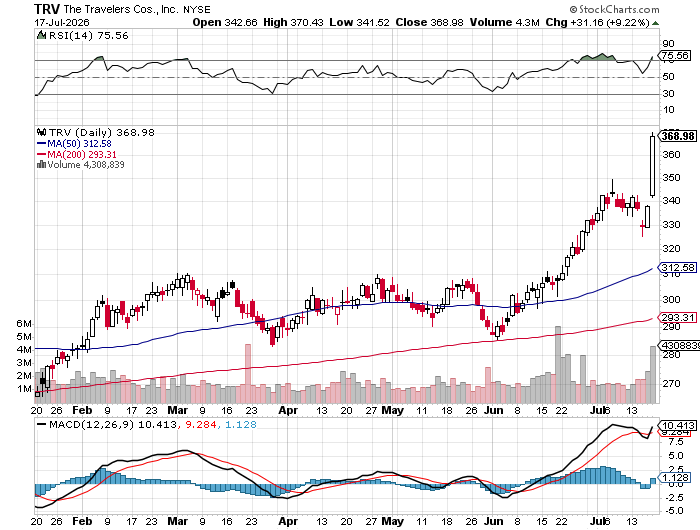
Insurance stocks tend to grind rather than sprint, so a clean 8% gap on earnings stands out on the chart. The move reflects a market that was positioned for a more ordinary quarter and instead got an exceptional one. The open question the tape now has to answer is whether investors treat this as a step-change in earnings power or, more soberly, as one unusually calm quarter in a business defined by its lumpiness.
Inside the business: how Travelers actually makes money
A property-casualty insurer earns money two distinct ways, and understanding the split is the key to reading this quarter.
Underwriting profit is the first. Travelers collects premiums and pays out claims; if premiums (minus expenses) exceed claims, the underwriting itself is profitable. The scorecard for this is the combined ratio — claims plus expenses divided by premiums. Below 100 means the insurer makes money on the policies before earning a cent from investing; above 100 means it loses money on underwriting and has to make it up elsewhere. Travelers’ 83.6 this quarter is an unusually strong reading, meaning the core insurance business was highly profitable.
Investment income is the second engine. Insurers hold the premiums they collect — the “float” — and invest it, largely in bonds, until claims come due. In a world of higher interest rates, that investment income has become a steadier, growing contributor to results across the industry.
The company runs this across three segments. Business Insurance covers commercial customers and is the largest. Bond & Specialty Insurance handles surety and management liability. Personal Insurance is auto and homeowners. The mix matters because homeowners and other property lines are where catastrophe losses land — which is exactly the lever that swung this quarter.
Why the market rewarded it
Three things drove the reaction. First, the sheer size of the earnings beat — nearly doubling the estimate is rare for a company this large and this closely followed. Second, the combined ratio at 83.6 signaled genuinely strong underwriting discipline, not just a one-off. Third, a 24.9% core return on equity is the kind of profitability number that makes investors re-rate how much a stock is worth, at least for a moment. Put together, they made a Dow insurer look like a growth stock for a day.
There is also a rate-environment tailwind underneath it. Higher yields on the investment portfolio have lifted income across the sector, and that part of the story is more durable than the weather-driven part.
The case for caution
Here is the discipline this quarter demands, stated plainly: a very large share of the beat came from catastrophe losses being unusually low. Pre-tax catastrophe losses were $518 million, versus $927 million a year earlier. That roughly $400 million swing is not a sign the business got fundamentally better — it is a sign the weather was kinder. Catastrophe losses are inherently unpredictable, and Q3 contains the heart of hurricane season. A single major storm can turn a benign quarter into an expensive one, and a combined ratio of 83.6 is not a level any insurer sustains through an active catastrophe year.
The revenue line reinforces the point. Sales grew just 0.3% and slightly missed estimates, so this was not a quarter of accelerating growth — it was a quarter of exceptionally clean profitability, and the cleanliness was partly borrowed from a quiet storm season. Paying a higher price for an insurer on the back of its lowest-catastrophe quarter is the classic way to be surprised when the weather turns.
None of that makes the quarter fake. The underwriting was real and the investment income is durable. It simply means the headline number and the run-rate are two different things, and the gap between them is measured in storms that have not happened yet.
What to watch next
The immediate tell is whether TRV holds the gap at Monday’s open and beyond; insurance rallies built on a calm quarter can fade when the next storm forecast rolls in. Beyond the tape, the numbers to track are the underlying combined ratio — which strips out catastrophes and prior-year reserve movements, and is the truest read on core underwriting — and net investment income, the durable tailwind. And because this is an insurer, the most important variable for next quarter is not on any earnings slide: it is the weather. An active Atlantic hurricane season would test exactly the strength this quarter showcased.
The bottom line
Travelers delivered an excellent quarter: profit up 46%, core earnings nearly double expectations, a combined ratio in the low 80s, and a 25% core return on equity. The underwriting discipline and the higher investment income are real and repeatable. But a meaningful slice of the beat was a light catastrophe quarter, and that part is not something anyone can bank on. If you are looking for evidence that Travelers runs a strong, profitable insurance operation, this quarter is it. If you are tempted to extend a low-storm quarter into a permanent earnings jump, the sky has a vote — and it has not cast it yet.
Get the next Top Stock Pick in your inbox — free.
Recent Top Stock Picks
This report is for information purposes only, and is neither a solicitation or recommendation to buy nor an offer to sell securities. TopStockPicks.co is not a registered investment advisor and is not a broker-dealer. TopStockPicks.co has NOT BEEN COMPENSATED for coverage of TRV. TopStockPicks.co and its affiliates or officers may buy and sell shares of TRV in the open market at any time without notice. TopStockPicks.co does not set price targets on securities. Always do your own due diligence and consult your financial advisor. Never invest into a stock discussed by TopStockPicks.co unless you can afford to lose your entire investment.