A double beat and a lifted full-year forecast sent $ABT up almost 11% in a single session — not on hype, but on the two businesses quietly carrying the company: medical devices and diagnostics.
Wall Street does not usually pay up for a company this size to move 11% in an afternoon. Abbott Laboratories carries a market value north of $170 billion, the kind of mega-cap that typically drifts a percent or two on an earnings day and moves on. So when $ABT jumped almost 11% on July 16 after its second-quarter print, the size of the reaction told you something the headline number alone did not: the market had been braced for a stumble, and got the opposite. The full coverage is worth reading straight from the source — CNBC and Yahoo Finance both broke down the beat-and-raise in detail.
This profile walks through what Abbott actually reported, why a mature healthcare giant re-rated on a single quarter, what the four engines under the hood are really doing, and — just as importantly — the case for caution now that the easy money has already been made.
Company snapshot
- Company: Abbott Laboratories · Ticker: ABT (NYSE)
- Sector: Healthcare · Diversified medical products
- Headquarters: Abbott Park, Illinois · Founded 1888
- CEO: Robert B. Ford (chairman & chief executive)
- Four segments: Medical Devices · Diagnostics · Established Pharmaceuticals · Nutrition
- Dividend: a “Dividend King” — 54 consecutive years of increases
- Approx. market cap: ~$170B+ · Recent price: ~$100 (Jul 17, 2026)
Snapshot figures are widely reported company facts; the recent price and Q2 results are sourced below.
What actually happened
Abbott reported second-quarter 2026 results before the bell on July 16 and cleared the bar on every line that matters. Adjusted earnings came in at $1.31 per share against a Street estimate of $1.28 — a beat. Revenue landed at $12.59 billion versus roughly $12.52 billion expected — a second beat. And then management did the thing that turns a good quarter into a re-rating: it raised full-year guidance, lifting the adjusted EPS range to $5.45–$5.60 from a prior $5.38–$5.58, while reaffirming its full-year comparable sales growth outlook of 6.5% to 7.5%.
A “double beat and a raise” is a specific, meaningful signal. Anyone can beat a lowered bar for one quarter. Raising the full-year forecast is management putting its credibility on the next two quarters — companies do that when the underlying demand is real and durable, not when a quarter got lucky on timing or currency. The market read it exactly that way.

The numbers that moved it
| Metric | Q2 2026 result | Street / prior |
|---|---|---|
| Adjusted EPS | $1.31 | $1.28 est. |
| Revenue | $12.59B | $12.52B est. |
| Comparable sales growth | +4.8% | — |
| Gross margin | 58.0% (+100 bps) | — |
| FY26 adj. EPS guidance | $5.45 – $5.60 | raised from $5.38 – $5.58 |
| Stock reaction | ~$89 → ~$99 | +10.7% on the print |
Sources: Abbott Q2 2026 release (SEC 8-K), Yahoo Finance, TipRanks, Investing.com earnings transcript. Figures adjusted / non-GAAP as reported.
The detail that anchors the whole story is gross margin: it expanded a full percentage point to 58.0% of sales. Margin expansion at Abbott’s scale is not a rounding error — it is the difference between growth that costs money and growth that prints it. A higher-margin sales mix is exactly what lets management raise the profit forecast without promising a revenue miracle.
Six months of tape
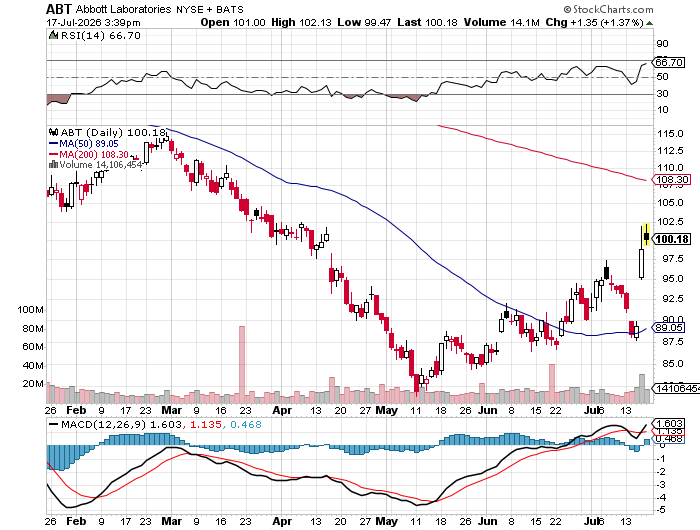
The chart tells the fuller story the one-day pop hides. Abbott had drifted from the $110s down toward the high $80s through the spring, underperforming a market obsessed with AI and semiconductors. The earnings gap did not launch the stock to new highs — it reclaimed ground the stock had already given back. That matters for how you frame the move: this was a recovery of lost confidence, not a breakout into blue sky.

Inside the business: four engines, not one
Abbott is unusual among large-cap healthcare names because it is genuinely diversified across four distinct businesses, each large enough to be its own company. Understanding which ones drove this quarter is the difference between chasing a headline and understanding a franchise.
Medical Devices is the growth engine and the star of this print. It houses Abbott’s continuous glucose monitoring franchise — the FreeStyle Libre line — which has become one of the most successful medical-device products in the world by making glucose tracking cheap, wearable, and mainstream well beyond insulin-dependent diabetics. The segment also spans structural heart (devices like MitraClip and TriClip that repair heart valves without open surgery), electrophysiology, and heart failure. This is the highest-growth, highest-narrative part of Abbott, and it is doing the heavy lifting.
Diagnostics is the second engine and the quarter’s other tailwind. Abbott runs core laboratory systems, rapid and point-of-care testing, and molecular diagnostics. This business exploded during the pandemic on COVID testing, then had to lap those impossible comparisons — a multi-year headwind that is now largely behind it. With the COVID distortion cleared, the underlying base business growth shows through, and that normalization is part of why guidance could go up.
Established Pharmaceuticals is the steady-emerging-markets engine: branded generic medicines sold largely in developing markets, a durable, cash-generative business that does not grab headlines but smooths the cycle. Nutrition is the fourth — the Similac infant-formula and Ensure/Glucerna adult-nutrition brands. It is a slower grower and has weathered real controversy in recent years, but it remains a globally recognized consumer-facing anchor.
The investment case for Abbott has always been that these four engines rarely stall at the same time. When diagnostics normalizes, devices accelerate; when one geography softens, established pharma in another picks up the slack. This quarter you saw the thesis work in real time: devices and diagnostics carried the raise.
Why the market rewarded it
Three things stacked up. First, the beat was broad, not narrow — EPS and revenue both cleared, so there was no “beat on cost-cutting, missed on demand” asterisk. Second, the guidance raise removed a fear rather than added a promise; investors had been positioned for Abbott to sound cautious into the back half, and management sounded confident instead. Third, and most underrated, the margin expansion validated the mix: Abbott is selling more of its most profitable products, which is the healthiest reason for a profit forecast to go up.
There is also a rotation story. With the AI/semiconductor trade unwinding through July, capital has been looking for quality outside of tech — durable earners with real cash flow and dividends. Abbott, a company that has raised its dividend for 54 consecutive years, is precisely the kind of name that benefits when the market’s appetite swings from momentum back toward defensiveness. The earnings gave that rotation a reason to land on ABT specifically.
The case for caution
The single most important fact for anyone looking at Abbott today: most of the good news is now in the price. An 11% pop means you are no longer buying this franchise cheap — you are buying it after the market has already re-rated it for the beat and the raise. The asymmetry that existed at $89 does not exist at $100.
Beyond valuation, the watch-items are specific. Diagnostics still has to prove its post-COVID base can grow steadily rather than merely stop shrinking. The Nutrition segment carries ongoing legal and reputational risk that has flared before and could again. And a raise sets a higher bar: management has now told the Street to expect $5.45–$5.60 for the year, which means the next two quarters have to deliver against a number Abbott itself chose to lift. A blue chip that raises and then trims is punished harder than one that never raised at all.
None of this is a red flag. It is the ordinary reality that a great quarter and a great entry price are two different things, and today Abbott is offering the first, not the second.
What to watch next
The immediate tell is simple: does ABT hold the gap. A beat-and-raise that gives back its entire move within a week is the market quietly disagreeing with management’s confidence. A stock that consolidates and builds on the level is the market endorsing it. Beyond the tape, the next real information comes with Q3 results, where devices growth (especially FreeStyle Libre) and the diagnostics base rate are the two numbers that will confirm or challenge the raised guidance. Watch the dividend, too — for a Dividend King, the next increase is a signal of management’s confidence in the very cash flows this quarter just re-rated.
The bottom line
Abbott did something mature companies rarely do: it beat on both lines, raised the full-year outlook, and expanded margins all at once — and the market believed it enough to add nearly 11% to a $170-billion company in a day. This was quality being rewarded, not a meme being chased. The franchise is as diversified and durable as any in large-cap healthcare, and the two engines that matter most, devices and diagnostics, are working. The only real caution is timing: the discount is gone. If you are looking for a quality compounder and are comfortable paying up after a re-rating, Abbott just reminded everyone why it is a core holding. If you were hoping to buy it cheap, that window closed the morning of July 16.
This report is for information purposes only, and is neither a solicitation or recommendation to buy nor an offer to sell securities. TopStockPicks.co is not a registered investment advisor and is not a broker-dealer. TopStockPicks.co has NOT BEEN COMPENSATED for coverage of ABT. TopStockPicks.co and its affiliates or officers may buy and sell shares of ABT in the open market at any time without notice. TopStockPicks.co does not set price targets on securities. Always do your own due diligence and consult your financial advisor. Never invest into a stock discussed by TopStockPicks.co unless you can afford to lose your entire investment.